.png)
TL;DR: In May 2026, Shopify shipped a new admin page showing how AI tools rank and recommend your products. Klaviyo turned Customer Agent into a platform you can build custom AI workflows on. Markets released five updates that simplify cross-border. Gorgias Chat 2.0 stopped giving discounts to everyone. And Shein bought Everlane for $100M, signaling tighter capital in premium DTC.
What is Shopify's new Agentic Storefronts admin page?
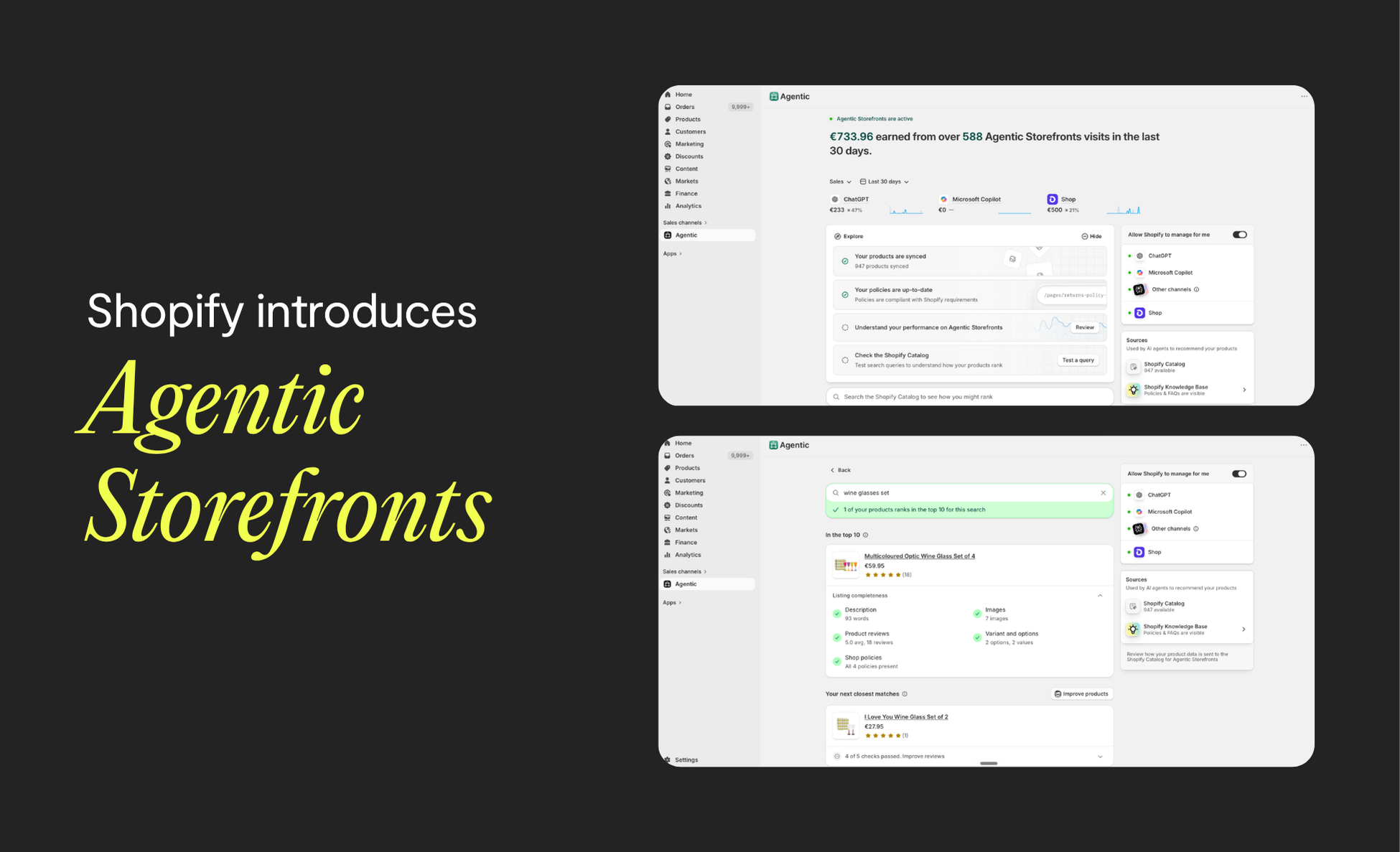
Shopify shipped a new page in your admin in May for Agentic Storefronts. Your products are now indexed and shown to ChatGPT, Microsoft Copilot, Perplexity and other AI shopping tools by default. The new admin page shows which platforms drive each order, which queries you rank for, and what to fix in your product data.
The page sits in the Shopify admin under sales channels. Shopify activated agent indexing by default earlier in 2026, but until May, merchants had no visibility into how AI tools were ranking or surfacing their products. The new dashboard exposes per-channel attribution, query matching, and product data recommendations. Around the same time, Shopify quietly turned on llms.txt files at yourstore.com/llms.txt (the file AI tools read to understand your store metadata) and launched Claude and ChatGPT apps for merchant admin work.
Why this matters. AI shopping isn't theoretical anymore. Shopify released numbers this month showing AI-referred shoppers convert 50% higher than Google traffic, spend 14% more per order, and Perplexity shoppers specifically spend 57% more than buyers from other AI platforms. AI-driven orders grew 13x year over year in Q1 2026. If your product data is messy, AI tools either don't surface you or surface you for the wrong queries.
Our take. GoodKarma's view is that being indexed and being recommended are two different problems, and most brands are only solving the first. Anyone on Shopify gets indexed for free. What separates the brands that show up in ChatGPT recommendations from those that don't is structured product data written for agents, not humans. Agent-readable titles, descriptions framed around who the product is for and what it solves, and clear "not for this kind of buyer" exclusions where they matter.
How do Shopify Markets updates from May 2026 change cross-border selling?
Shopify Markets shipped five updates in May 2026, all addressing the same problem: brands selling across countries off a single store. The updates cover market-specific discounts, gift cards in local currency, unified branding, multiple legal entities on Shopify Payments, and market persistence between accounts and the storefront.
The five updates in detail:
- Market-specific discounts. Run a 20% sale on Germany or free shipping only in the UK with one toggle, instead of duplicate codes or custom logic.
- Gift cards in local currency. Buyers in Germany pay in euros, buyers in Switzerland in CHF, rather than everyone using your shop's base currency.
- Unified branding across checkout, accounts and sign-in. One set of brand settings in the editor flows through everywhere a buyer sees you.
- Multiple legal entities on Shopify Payments. Useful if you run a Dutch BV and a German GmbH both selling into Germany from one store.
- Market persistence between accounts and storefront. A buyer in the Dutch market stays in the Dutch market when they log into their account.
Why this matters. Most lifestyle brands sell EU, UK and US off a single store and have built a stack of workarounds for it: a duplicate Shopify for the wholesale entity, a currency app, a region app, custom code nobody wants to touch. A meaningful chunk of those workarounds is now redundant. Conversion improves when the buyer experience stops feeling jumbled mid-session.
Our take. When GoodKarma audits lifestyle brands selling cross-border, the workaround stack tends to be invisible. Owners often don't know they have three apps doing what Shopify Markets now does natively. The right move is a Markets audit before any peak season, not a panic migration in the middle of one. Each retired app should be tested in a single market first.
What is Klaviyo Customer Agent's Custom Skills update and what can lifestyle brands build with it?
Klaviyo expanded Customer Agent with three updates in May: Custom Skills, Custom Tools, and Agent Guidance. Custom Skills lets brands build their own AI workflows in plain English with no engineers. Custom Tools lets the agent connect to any external system in the tech stack. Agent Guidance lets brands set rules of behaviour so the agent stays on-brand.
Customer Agent used to be a fixed catalog of pre-built skills, mostly order tracking, returns, and basic recommendations. The May updates change that. Brands now define their own logic in plain language, build skills from scratch, customize how existing ones behave, and connect to anything in the tech stack: store locators, appointment booking, warranty claims, subscription management.
Why this matters. The shape of "AI customer experience" stops being whatever Klaviyo shipped out of the box and becomes specific to the brand. A wellness brand could build a routine advisor that connects to its subscription system. A fashion brand could build a styling concierge that pulls from inventory metafields. A home brand could build a furniture-fit checker.
Our take. GoodKarma's perspective is that this is the first time Customer Agent is a real platform for lifestyle brands. The win condition is treating it like a product, not a tool. Specific workflows, specific personas, specific outcomes. The brands that get the most from it map high-volume buyer journeys, not the ones that try to automate tier-one support generically.
Klaviyo discount codes can finally stack with site-wide discounts at Shopify checkout
Yes. As of May 2026, Klaviyo-generated Shopify discount codes can be configured to combine with other discounts at checkout. Until now, if a customer used a Klaviyo email code at checkout and your site also offered free shipping over €100, Shopify would zero out one of the two. The fix is a toggle when creating or editing the Klaviyo coupon.
Why this matters. Two things stop happening for brands running concurrent campaign and site-wide promotions. Customer service tickets that say "my code didn't work" decrease. And lost revenue when a buyer abandons because the discount didn't apply the way they expected.
Our take. Small feature, real revenue impact. GoodKarma's experience is that brands running 10+ campaigns a month should audit which codes should stack and which shouldn't before the next promotional cycle. The toggle is per campaign, not a default, so it pays to be deliberate.
What is Gorgias Helpdesk 2.0 and how does intent-based discounting work?
Gorgias Helpdesk 2.0 launched with two changes: intent-based discounting and a full shopping surface inside the chat widget. Intent-based discounting reads buyer behaviour and only offers a discount when the widget detects hesitation, rather than offering one to every visitor by default. The shopping surface lets buyers browse, compare and buy without leaving the conversation.
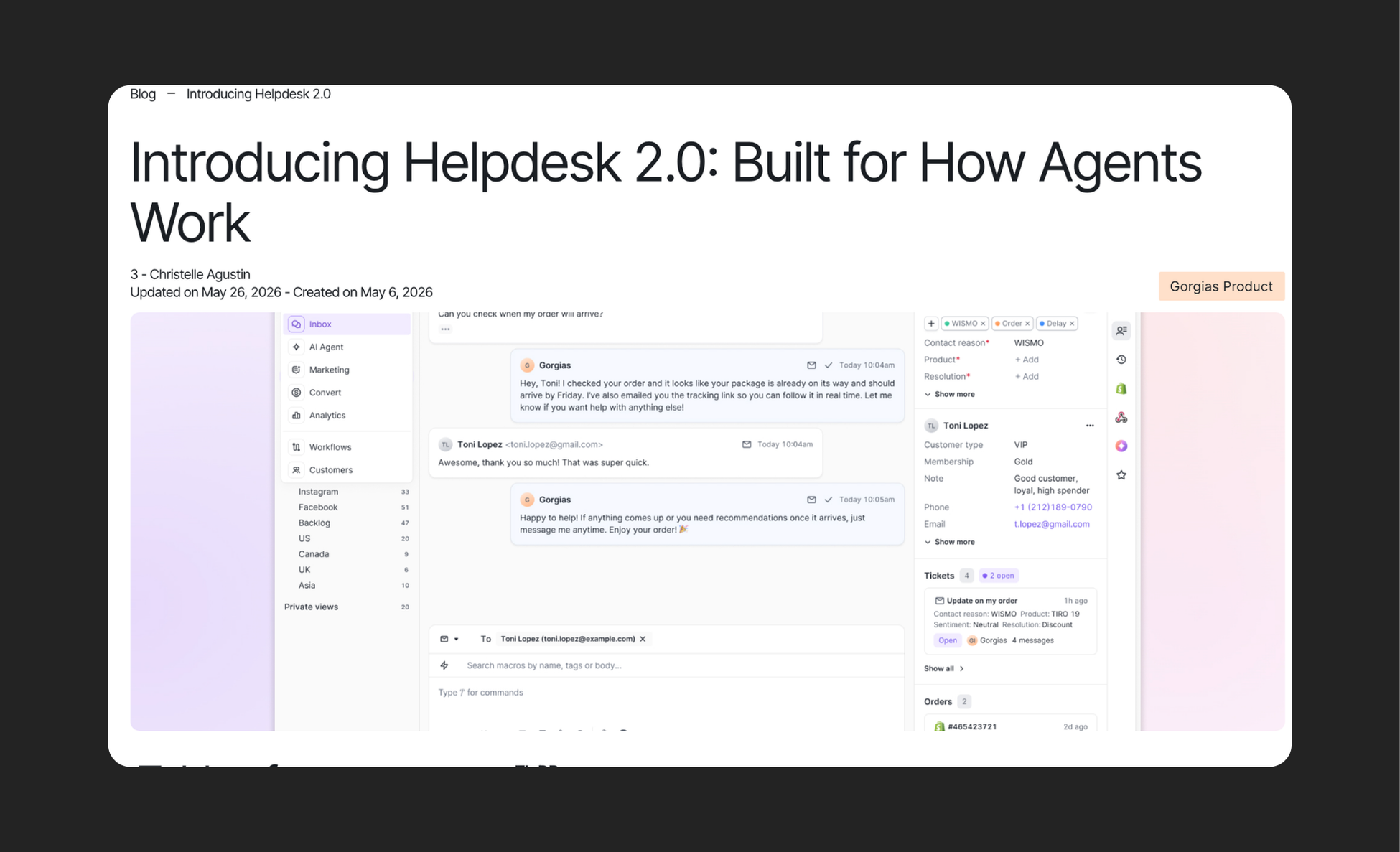
Why this matters. If your chat widget auto-offers a 10% code to everyone who opens it, you're paying customers who would have bought anyway. Intent-based discounting closes that leak. The shopping surface turns the widget from a support tool into a checkout surface.
Our take. GoodKarma's experience is that chat discount logic tends to be set up once during onboarding and never revisited. The Chat 2.0 update is a forcing function to look at it. Most brands GoodKarma audits over-discount through chat by 15-25%. The right move on launch is tuning the hesitation triggers, not disabling discounts entirely.
Why did Shein buy Everlane and what does it mean for premium DTC?
On May 16 2026, Shein acquired Everlane for $100 million from majority owner L Catterton. Everlane was carrying $90 million in liabilities going in, including a $25 million Gordon Brothers loan and a $65 million asset-based revolver. The deal valued Everlane at roughly one tenth of its peak valuation and gives Shein a higher-end US foothold.
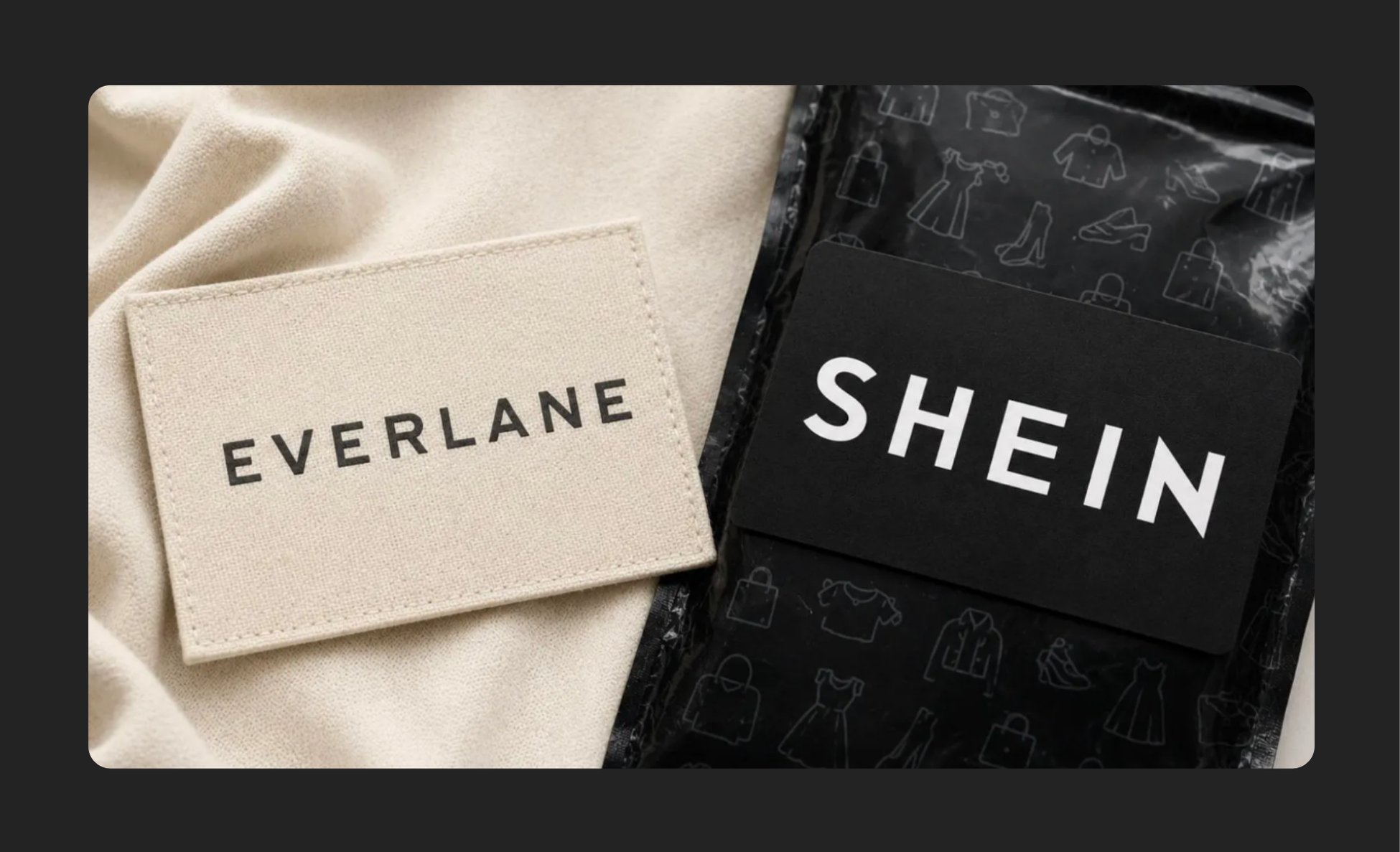
Everlane spent the last decade selling millennials on sustainability and "radical transparency" pricing. Shein is the ultrafast-fashion brand that represents the opposite of those values. The deal closed quickly after L Catterton ran out of patience with the brand's financial position.
Why this matters. Everlane was the prototype premium DTC brand. A values-led, online-first poster child selling at one tenth of its peak valuation to a fast-fashion competitor is the clearest signal yet that capital and patience in the premium DTC space have tightened. It doesn't say DTC is over. It says the brands surviving the next few years will be the ones whose unit economics work without endless growth funding. The Everlane case isn't really about sustainability or brand authenticity. It's about debt structure and unit economics. The brand survived as long as it did because capital was cheap. When it wasn't, the values couldn't service the loan.
Our take. GoodKarma's view is that the next 24 months will reward operators who measure their business by repeat rate, contribution margin, and returning customer revenue, not just topline growth. Building a brand people love and a brand that can actually scale has always been a tricky balance. The brands that test, validate, and act on their actual data, instead of on what they think their customers care about, are the ones that stay independent.
Other Shopify updates worth knowing in May 2026
A short list of smaller May 2026 updates any operator on Shopify should be aware of:
- Shopify Messaging sends SMS automations natively. Abandoned cart and checkout SMS directly from Shopify, no third-party. Not a Klaviyo replacement yet, but the start of a longer story.
- Annotations in Shopify Analytics. Charts now show markers for what changed in the store on a given day (theme deploy, product change, app install). Less time guessing why a metric moved.
- Refunds as store credit from admin and POS. No third-party app needed. Direct way to reduce cash refund leakage.
- Apply discounts on the refund page. When you partial-refund an item, refund maths now line up with original order discounts.
- Product Variant Publishing per channel. Publish or hide individual variants per sales channel and catalog.
- Customer accounts sign-in page is now fully customizable. Two-column layout, brand image, typography and colours in the editor.
- Sidekick generates Flow test cases. Test a Shopify Flow against real shop data before activating, so you don't break production.
Next steps for May → June
A checklist for lifestyle brand operators based on May's updates:
- Open the Agentic Storefronts page in your Shopify admin. Look at which queries you rank for and what Shopify recommends fixing in your product data.
- Audit your product feed. Titles, descriptions, sizing, reviews. Sharpen for agent readability.
- Pull a list of every cross-border workaround you currently run. Cross off what's no longer needed after the Markets updates.
- Plan one Markets workaround deprecation as a test, in a single market.
- List the three highest-volume customer questions your team gets that aren't served well by Klaviyo's default skills. Brief whoever owns retention.
- Toggle Klaviyo discount code combination on your next email campaign.
- Audit Gorgias chat discount rules. If the team can't articulate the rule, that's the audit.
- Run a quarterly review of repeat rate, contribution margin, and returning customer revenue.
Talk to GoodKarma
If you run a lifestyle brand on Shopify and Klaviyo and want help auditing your AI-readiness, Markets setup, or retention stack ahead of peak season, book a call with GoodKarma below.
Share on:


.png)
.png)