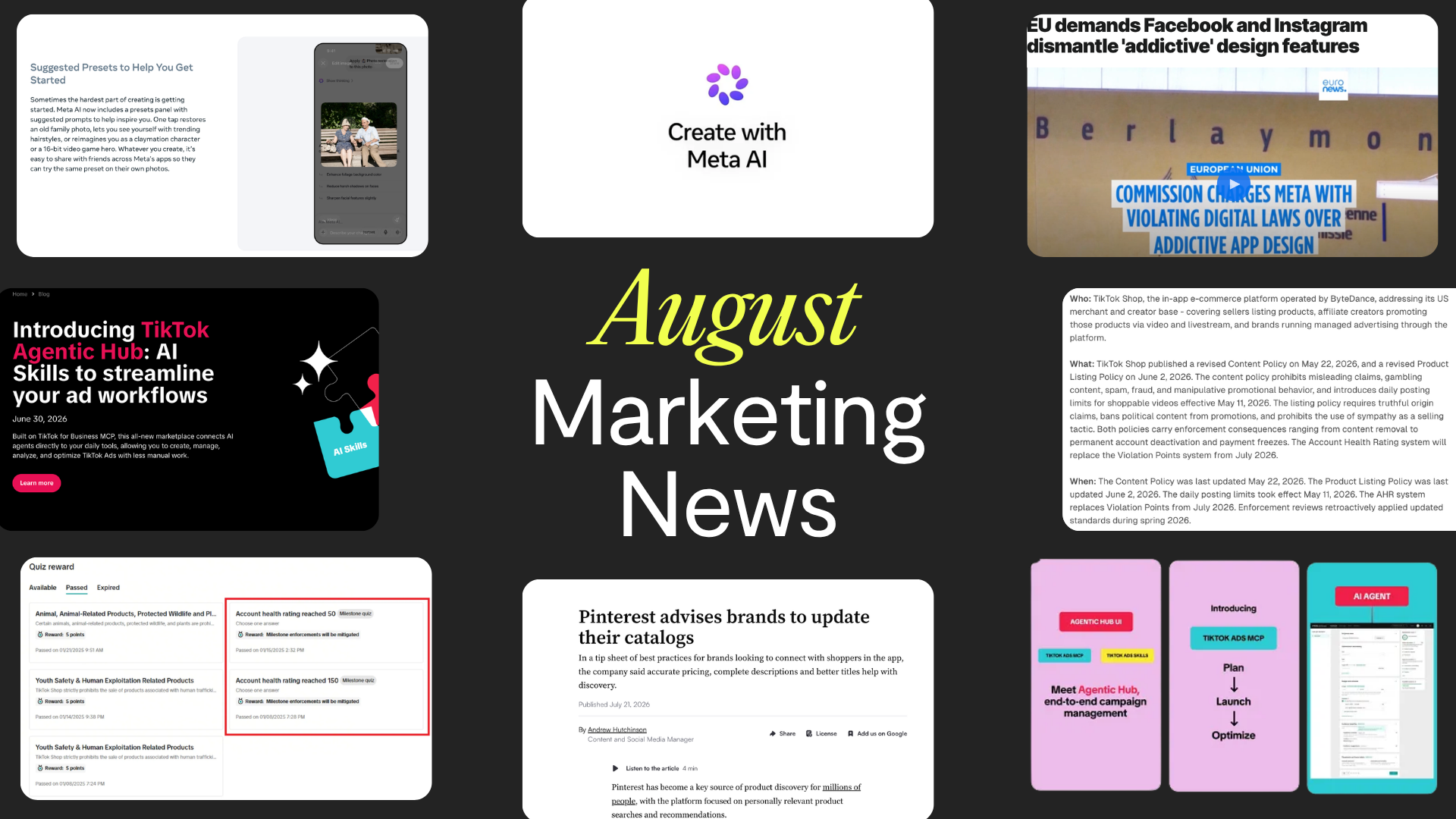
TL;DR: TikTok opened Agentic Hub on July 6, a marketplace of AI skills built into Ads Manager, including a ready-to-use ad-rotation diagnostic that flags fatiguing creative before you spot it manually. Pinterest published hard catalog numbers on July 21 that tie straight to ROAS. Meta's first in-house image model, Muse Image, is heading into Advantage+ creative, and it's worth auditing any creative enhancements you've turned off, since Muse replaces the model that caused the quality issues in the first place. Separately, the EU Commission found Instagram and Facebook in breach of the Digital Services Act over addictive design. Here's what each one means for your accounts.
Meta
Muse Image is coming to Advantage+ creative, and it's worth checking your settings now
Meta's first in-house image model, Muse Image, launched July 7 and will reach Advantage+ creative "in the coming weeks" (global timeline not yet confirmed). It reasons through a full creative brief rather than a single prompt, and early advertiser feedback points to real gains in photorealism and product accuracy.
Here's the part worth acting on now, not later: Advantage+ Creative Enhancements have been on by default since Meta merged manual and Advantage+ campaign setup into one flow, every new Sales, Leads, and App campaign launches with all enhancements switched on unless you turn them off individually. A lot of brands turned specific enhancements off over the past year because the output quality wasn't there, mismatched backgrounds, warped product shots, mistimed music. Muse replaces the model behind that exact pipeline. If you opted out of any Advantage+ Creative Enhancement for quality reasons, that decision was made against the old model, not the one about to ship.
Do this now: check Ads Manager under Ad Level > Optimize Media for any enhancements you've switched off, and flag them for a re-test once Muse reaches your account. It sits inside existing Advantage+ creative, no new campaign type, no new setup. And the underlying gotcha stays the same: Andromeda still groups near-identical creative into one asset regardless of how it's generated, so treat Muse variants as fuel inside a concept, not new concepts. If a variant includes an AI-generated person, standard AI-content disclosure rules still apply.
The EU found Instagram and Facebook in breach of the Digital Services Act
On July 10, the European Commission published preliminary findings that infinite scroll, autoplay, push notifications, and Meta's personalized recommendation systems on Instagram and Facebook violate the DSA's rules on protecting user wellbeing, particularly minors. The Commission wants Meta to disable autoplay and infinite scroll by default, add real screen-time breaks, and make recommendations less engagement-driven. If confirmed, Meta faces a fine of up to 6% of global annual turnover. Commission president von der Leyen said focused proposals are coming "after the summer."
Nothing's confirmed yet, Meta gets to respond before any final decision. But if you run EU spend, this is worth tracking closely. Forced changes to autoplay and infinite scroll defaults would shift organic reach and possibly ad delivery dynamics on Reels and Stories for your EU audiences specifically. Not an action item today, a line item on the radar.
TikTok
Agentic Hub is live: TikTok's ad platform now runs on AI skills
TikTok published Agentic Hub on its own For Business blog on July 6, a marketplace of AI "Skills" built on TikTok's MCP server. First-party skills from TikTok are ready inside Ads Manager now. Third-party skills from partners like HubSpot, Wix, and Constant Contact need their accounts connected through the Hub first.
.png)
Worth naming a concrete example rather than just saying "go browse it." TikTok's own ad-rotation diagnostic skill compares each running ad's recent engagement against both its own prior baseline and its current same-objective peers, then classifies every ad as Retire, Scale, or Watch, with the size of the drop and spend at risk attached. It's read-only, it flags fatiguing creative, it doesn't touch your ads, the actual swap still goes through you. It also picks the right metric per objective automatically (CVR/CPA for conversion ads, cost-per-view for video-view ads, CPM for reach, CTR for click campaigns), so it won't misjudge a view-focused ad for having low clicks by design. That's a good first skill to connect if your team is manually eyeballing ad fatigue every week.
A couple of the named third-party skills aren't a direct fit for lifestyle brands, Constant Contact's launch skills are built for real estate, HubSpot's is CRM-lifecycle matching, but they're useful as a preview of what third-party skills actually look like once they land. More partner skills are expected through August.
Pinterest just told you exactly what's holding your catalog back
Pinterest published a best-practices tip sheet on July 21 with real numbers attached. Titles with brand keywords see 28% higher ROAS. Titles with pattern keywords (think "summer wedding guest dress" instead of a generic product name) see 22% higher ROAS. Ad groups with fewer than 100 SKUs run 13.6% lower ROAS, so Pinterest recommends at least 500 SKUs per group rather than splitting into thin subgroups.
.png)
On tracking, advertisers running Conversions API alongside the Pinterest Tag see a 9.0% improvement in average CPA and 23.7% more attributed conversions compared to tag-only setups. No platform update needed on your end, just an hour with your catalog. Pull your ten highest-spend product titles, check them against how people actually search, and confirm pricing on the Pin matches pricing on the landing page exactly.
Share on:


.png)