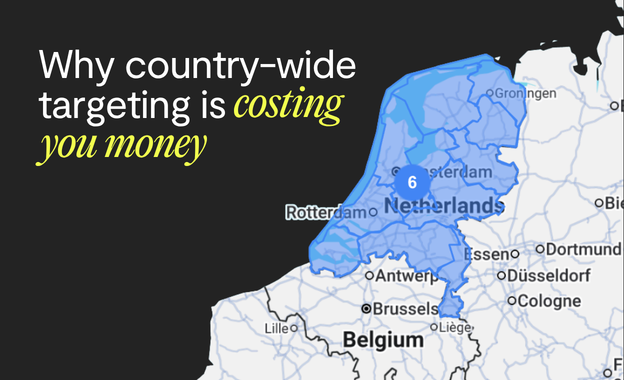
Letting the algorithm loose on an entire country vs. targeting the specific locations that generate the most revenue, for lower ad costs.
Most e-commerce brands run paid media the same way. Pick a country, decide on a strategy, launch the campaigns, and never touch the location setting again. The problem is that within any country, performance is never uniform. Some regions generate new customers at a fraction of what other regions cost. And, some cities might generate a lot of absolute revenue but for a much lower ROAS compared to your overall country ROAS.
The question every brand should be asking is, where is my money actually coming from? And what is it costing me to get a customer in each city or region? The data is already sitting in your account. You just have to actually look at it and decide where the budget should go based on what you find.
Below is the full breakdown: how to run the analysis, how to identify your best and worst-performing regions, and how to adjust your paid media strategy based on what you find. After that, two real examples from our own client base that show how this played out for them.
The method
Finding out how specific parts of a country are performing requires data, which means it also requires patience. You can't do this on day one. You have to run campaigns at the country level long enough to have something to look at. Our advice? Make sure you have at least 100 conversions within a country before you start analysing. Below that, the regional samples are too thin and you'll be optimising against noise rather than true patterns. The temptation to cut early is real, especially with a region that "looks bad" after a week. Resist it. Let the campaigns run in an entire country first, then use that data to make smarter decisions.
Once the data is there, the analysis is quite simple. Pull the average of at least three important metrics that you find important in performance reporting. For example, ROAS, CPC, and conversion rate. That's your baseline. Now segment the same data by region, then by city. A region or city performs well when its three metrics all sit on the right side of the country average. A region or city where all averages sit on the wrong side compared to the country averages are the ones quietly draining your results.
You will usually find a few patterns when doing this analysis. The most common one is a capital city you have been treating as your top market that turns out to be quietly expensive. Big revenue numbers on the surface, high CPCs and below-average ROAS underneath. Then there's the opposite; A region nobody on the team has been paying much attention to, that's converting at a much better rate than the headline cities. And sometimes it's a few smaller cities you'd never have thought of as a market for the brand at all, doing real work in the account that nobody's been crediting them for. The data was always there. Country-average reporting was just hiding it. From there, the job is mostly to act on what's in front of you.
Now that you have identified your best and worst-performing locations, what do you do with these insights? You have two levers, and they're not mutually exclusive.
- Keep the country-wide campaign and exclude the regions that aren't pulling their weight.
- Build separate campaigns that target only the best regions.
Both work. Which one fits depends on what your brand needs right now. If you're worried about audience size, or you want to stay visible across most of the country, start by excluding the underperformers from your existing campaigns. If you want to be a little bit bolder, launch a separate campaign that only targets your best performers. Either way, you're concentrating your budget on the locations that are actually driving your revenue at a cost you can defend.
.png)
Optimising a mature market: Colourful Rebel
Here's how this played out for one of our clients. Colourful Rebel is a fashion brand running paid media in the Netherlands. At first glance, Amsterdam was their top market. This capital city generated the highest absolute revenue numbers in the account, easily. That kind of headline is hard to argue with at first glance, and for a while we hadn't.
Then we looked at the metrics underneath. CPCs in Amsterdam were significantly higher than the country average whileROAS was lower. The reason wasn't a mystery: every Dutch fashion brand bids in Amsterdam. The auction is crowded and the inventory is expensive. Therefore, buyers there are weighing more options before they convert. They're also more trend-driven and less brand-loyal, which makes them harder to keep once you've converted them. You're paying a competition tax for the privilege of showing up, and for customers who don't always stick around.
At the same time, regions like Zeeland and Drenthe were quietly converting at a fraction of the cost. On this auction, there was much less competition, thus, lower CPCs. Fewer brands fighting for the same shopper. The shoppers here behave differently too. They're often less trend-driven, more deliberate, and more likely to stay loyal to a brand once they choose one. The kind of buyer who's cheaper to acquire and more likely to come back
So we made the call to exclude Amsterdam from some of our campaigns entirely. We thereby concentrated the budget at the better-performing regions instead. Same brand, same creatives, same total spend. Just a simple location exclusion Here are the results after just a few weeks:
- ROAS: 6.42 to 13.29 (+107%)
- Conversion value: €8.3k to €17.8k (+114%)
- Conversions: 59 to 168 (+185%)
- CPC: €0.58 to €0.51, while scaling volume
That last point is worth pausing on. CPC went down while conversion volume nearly tripled. People usually assume that if you cut your audience, you lose conversions. But that's only true if those people were going to buy from you in the first place. At the prices Amsterdam's auction was charging, most of them weren't.
The key takeaway isn't that Amsterdam is a bad market. It's that Amsterdam is an expensive one. Colourful Rebel was paying premium prices for buyers they could reach much more cheaply in the rest of the country. The cheaper buyers were already in the campaigns. They were just being averaged in with the Amsterdam ones, so the brand never saw what they were worth on their own. Cutting Amsterdam didn't shrink the audience. It just stopped overpaying for it.
.png)
Entering a new market: No Label in Germany
Another situation where this analysis can come in handy is after entering a new market. A lot of our clients are expanding. Mostly into Belgium, Germany, or the UK. The default play for rolling out performance marketing in new countries is again; decide on a strategy, build audiences, set the location to the whole country and launch your campaigns. After a few months of running campaigns in a new marke, performance often dissapoints. Not disastrous, just a quiet, persistent sense that the numbers aren't what they're supposed to be. CPAs creep above target. Volume comes in slower than the projection.The first instinct is usually that something is wrong with the creative, the audience, or the positioning. Sometimes that's right. Often it isn't. After a while, you might even start questioning whether to keep running ads in that country at all. Sometimes that's right. More often, we can improve numbers significantly by concentrating budget on best-performing regions or cities rather than the entire country.
That was the situation with No Label. We had entered the German market and we were struggling. CPAs were too high and ROAS too low. We ran the same location analysis we'd run for Colourful Rebel and found a similar pattern: a handful of regions doing the lifting, and a long tail of regions either not converting at all or converting at a very high cost.
Rather than just trust the analysis on paper, we wanted to see it play out in a real test. So we ran two campaigns at the same time, side by side. One targeted all of Germany, the way the original campaign had been running. The second targeted only the regions the analysis flagged as the best performers. Everything else was identical: the same creatives, the same audiences, the same daily budget. The only difference between the two was the location setting.
The results were incredible. The campaign targeting only the best-performing regions came out clearly ahead.Compared to the campaign targeting the entire country, the focused one delivered:
- 49% decrease in CPA:
- 94% growth in conversions
- A stable but increased ROAS by +7%
So, Half the cost per acquisition. Nearly double the conversions. Same budget, more revenue. You can probably guess which one is still running ;)
The biggest learning, growing in a new market does not always require national wide targeting.. Once the data points somewhere, follow it. The thing slowing No Label's German launch wasn't Germany. It was the location setting telling the algorithm to look everywhere when it only needed to look in three places.
.png)
The bottom line
Two brands. Two markets. Two different problems on the surface. The same fix underneath: Understand the performance differences within one country and concentrate your budget on better performing regions and cities.
Doing this analysis and integrating it in your paid media strategy is one of the cheapest ROAS lift most brands have available. No new creative. No new landing pages. No extra budget. Just the discipline to treat location as a strategic decision, not a default setting.
Share on:




.png)