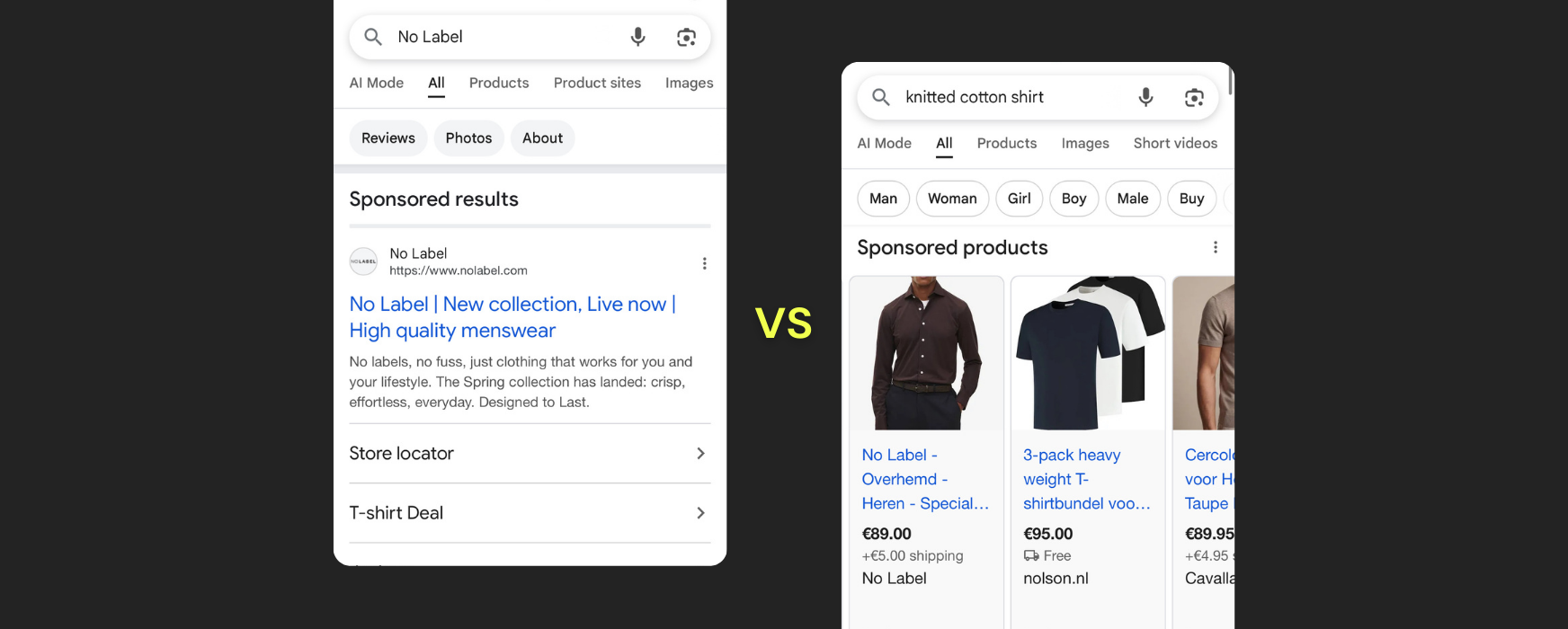
For many brands, Google Ads has quietly turned into a comfort zone. Search your own brand name. See yourself at the top. Celebrate the high ROAS. Report strong efficiency. Move on.
And while none of that is wrong, it’s often incomplete.
At GoodKarma, we regularly see brands investing the majority of their Google Ads budget into branded campaigns, sometimes 70, 80, even 90%. These campaigns target people who are already searching for the brand by name.
Branded campaigns are familiar. Predictable. Easy to defend. But they are also, by definition, limited in their ability to grow your business. If Google Ads is treated purely as a brand protection channel, you’re not using it as a growth engine - you’re using it as a safety net.
This article explains:
- Why branded campaigns became the default
- What role branded search should play
- Why non-branded (generic) search is where real growth happens
- And how brands can shift their mindset from efficiency-only to scalable acquisition
The traditional Google Ads setup: brand first, everything else optional
Historically, Google Ads was one of the first performance channels brands invested in. The logic made sense:
People already searching for your brand are:
- High intent
- Easy to convert
- Cheap to acquire
- Highly profitable
Branded campaigns do three important things:
1. They protect your brand space
Competitors can bid on your brand name. Branded campaigns ensure you stay visible, control messaging, and don’t lose demand you already created elsewhere.
2. They deliver high ROAS
Because intent is already there, branded search almost always outperforms other campaign types on paper.
3. They support existing demand
Branded search captures customers who discovered you via other channels.
All of this is valid. Branded campaigns matter. We actively recommend running them. The problem starts when branded search becomes the strategy, rather than one component of it.
The hidden risk of over-indexing on branded search
When most of your Google Ads budget is allocated to branded campaigns, a few things quietly happen:
You stop acquiring new customers
Branded campaigns don’t create demand. They harvest it. If someone searches for your brand, they already know you. Google isn’t introducing your brand — it’s just facilitating the final step.
You inflate performance metrics
High ROAS feels good, but it can mask stagnation. If 80% of spend goes to branded, performance looks efficient even when total revenue growth is flat.
You become dependent on other channels for growth
If Google only captures existing demand, then Meta, TikTok, PR, or offline activity are doing all the heavy lifting in awareness and discovery. That’s risky. It concentrates growth responsibility in fewer places.
Reframing Google: from brand capture to demand creation
At GoodKarma, we challenge brands to see Google differently. Not just as a place to protect what you already have, but as a channel to win customers who haven’t chosen you yet. This is where non-branded (generic) campaigns come in.
What are non-branded campaigns?
Non-branded campaigns target searches that:
- Describe a product category
- Reflect a problem, need, or use case
- Do not include a specific brand name
Examples:
- “best insulated bottle”
- “sustainable sneakers women”
- “waterproof leather boots”
These users are:
- High intent
- Actively comparing options
- Open to brand discovery
They are not loyal yet — and that’s exactly the opportunity.
Why non-branded search is harder (and why that’s okay)
Let’s be honest: non-branded campaigns are not easy.
They are:
- More competitive
- More expensive per click
- Less predictable
- Lower ROAS in isolation
This is where many brands pull back - often too quickly. But difficulty doesn’t mean inefficiency. It means investment.
Non-branded campaigns sit at the intersection of performance and brand building:
- You introduce your brand at the moment of intent
- You shape consideration
- You influence choice before loyalty exists
That’s powerful.
The mindset shift: efficiency vs growth
One of the biggest blockers we see is how success is measured.
Branded search optimizes for:
- Lowest CPA
- Highest ROAS
- Short-term efficiency
Non-branded search optimizes for:
- New customer acquisition
- Incremental revenue
- Market expansion
These goals require different expectations. If you judge non-branded campaigns by branded benchmarks, they will always look bad. But if you evaluate them through a growth lens, the story changes.
Key questions shift from: “Is this ROAS as high as branded?”
to:
- “Are we acquiring new customers?”
- “Are these customers returning?”
- “Is overall revenue growing?”
- “Is Google contributing to incremental demand?”
The real role of branded search in a growth strategy
Branded search should not disappear. It should be right-sized.
In a healthy Google Ads setup:
- Branded campaigns protect and capture existing demand
- Non-branded campaigns actively expand demand
- Budgets flex based on growth stage and market maturity
A rough rule of thumb we often see working:
- Branded: foundation, not focus
- Non-branded: growth lever
The exact split will differ per brand, category, and margin structure - but when branded consistently dominates spend, it’s usually a sign of underinvestment in growth.
Final thought: comfort doesn’t scale
Branded search is safe. It’s predictable. It’s comfortable. But comfort rarely leads to growth. If your Google Ads strategy mainly protects what you already have, you’re leaving potential on the table and handing opportunity to competitors who are willing to fight earlier in the funnel. Seeing Google as a new customer acquisition channel isn’t about abandoning efficiency. It’s about building a strategy that can actually scale. And that’s where real growth begins.
Share on:


.png)

.png)