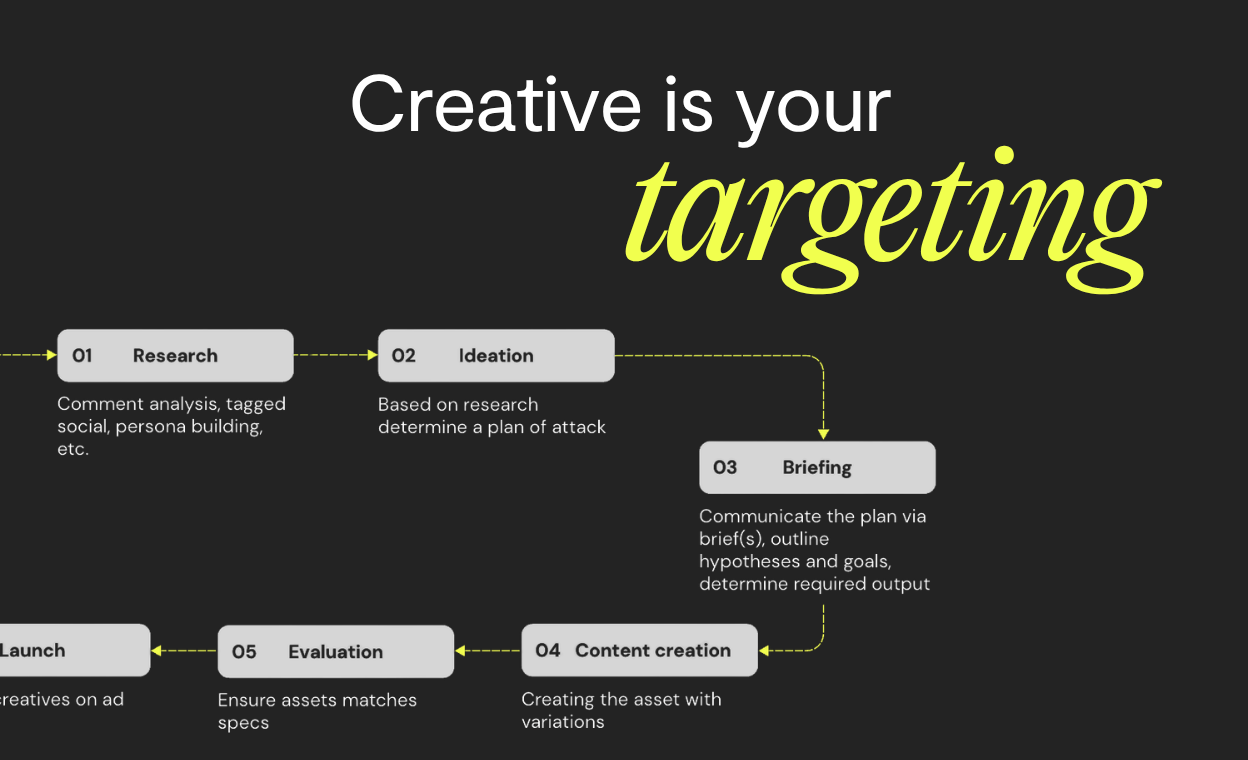
Your targeting is not the secret weapon. Your creative is.
For years, performance marketing rewarded control. You select interests, build custom audiences, and define demographics - you knew exactly who you wanted, you found them, and you won. But that model is changing.
Platforms are steadily moving toward automation. Tools like Advantage+ on Meta take on more of the audience-finding work, using machine learning to decide who sees your ad, when, and how often. Advertisers still set objectives and budgets, but the detailed targeting carries less weight than it once did.
So if the machine is running the targeting, what's left for you to own?
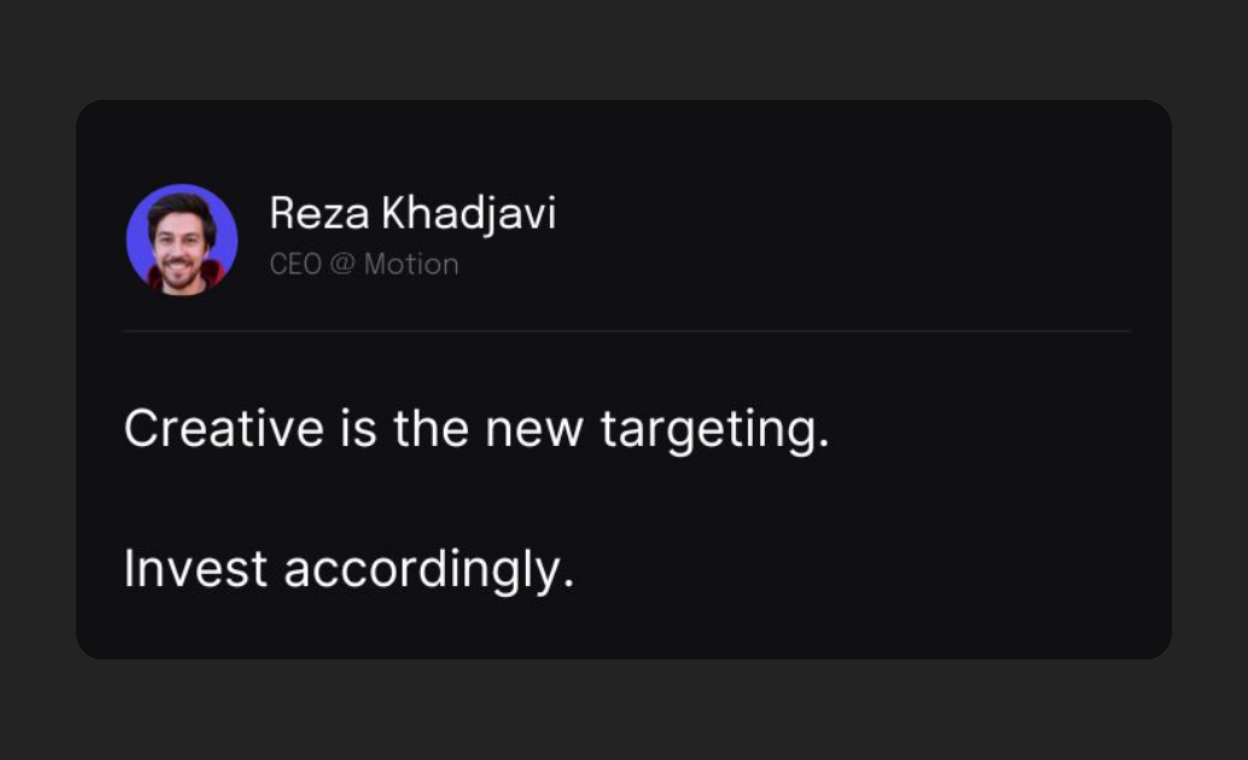
Your creative is doing more than you think
Targeting hasn't disappeared - it's just no longer the differentiator it used to be. Think about what actually happens when your ad goes live. The platform isn't only reading your audience settings. It's reading your creative: the hook, the format, the engagement signals it's likely to generate, and uses that data to decide where to push it.
Your creative isn't just a message anymore. It's a signal. It's telling the algorithm: this ad is relevant to these kinds of people. Serve it to them.
To make this concrete, picture two campaigns running side by side:
Campaign A has specific targeting - tight demographics, specific interests, and custom audiences built from months of data. The creative? Generic. Product photos, copy that could belong to any brand in the category, nothing that makes you stop scrolling.
Campaign B runs broad, with minimal targeting restrictions. But the creative is sharp: a story-driven video, real product in real hands, copy that actually sounds like a human wrote it for another human. People lean in. They watch. They click. Some of them weren't even in the "target audience."
Campaign B outperforms: not because targeting doesn’t matter anymore, but because the creative is doing the targeting. The platform sees strong engagement signals and pushes the ad further. The algorithm rewards it.
Why this is happening - and why there is no going back
These forces are driving this shift, and none of them are temporary:
1. Algorithms optimize for outcomes, using signals
Platforms increasingly use machine learning to decide what performs, and that’s based on how users respond to the creative itself. Creative quality becomes a key signal to the algorithm, influencing your campaigns’ performance.
2. Privacy reduces targeting precision
Privacy updates like cookie deprecation and stricter user data rules have made traditional targeting less accurate than it was just a few years ago. This means you have to rethink how you reach your audiences.
Taken together, these trends mean one thing: the creative execution is the only thing you can fully control. You can’t hack the algorithm or reverse privacy restrictions, but you can control what you put in front of people: the opening frame, the story angle, the emotional hook you build in the first few seconds. This is exactly why investing in creative strategy matters today.
Creative isn't a deliverable. It's a Flywheel.
Most brands treat creatives like a project. Brief goes in, ads come out, campaign launches. Then it sits. That's not a strategy, it's a production line with no feedback loop.
When a new client comes to us, one of the first things we do is audit their creative library. And what we usually find is the same thing: three to five ad variations, all built around the same core message and mostly static, campaign-style visuals.
The content is not bad, just very limited. If your creative diversity is narrow - one angle, one message, one format. When everything looks the same, it’s harder for the algorithm to find new people for you. The solution isn’t just launching more ads. It’s building a creative flywheel.
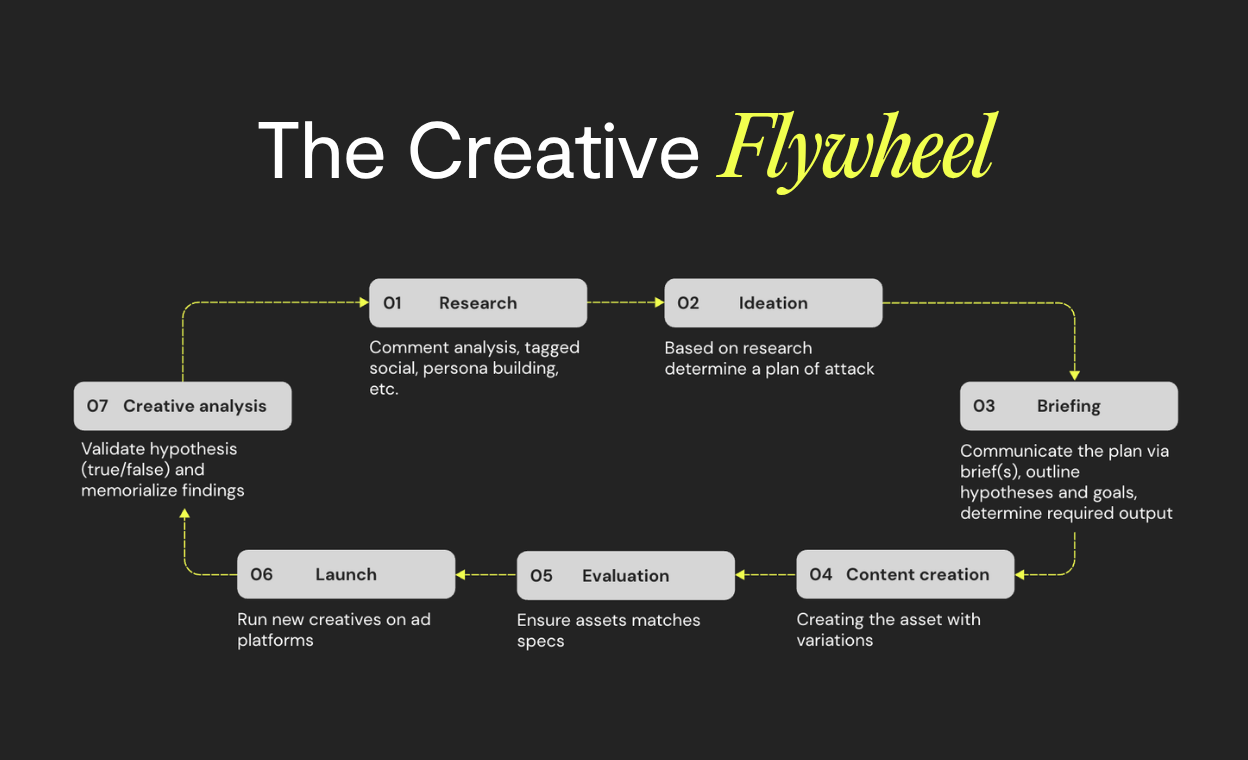
The Creative flywheel: This is where brands actually pull ahead
At GoodKarma, we believe creative strategy should be a Flywheel. A system where you continuously test, learn, and apply insights to improve not just your creatives, but also how they perform. It’s not a campaign you launch once and forget; it’s a process that keeps moving—and the key is: it never stops
The flywheel works because of creative diversity. The more angles, formats, and hooks you bring into the system, the more you have to learn from. Some audiences convert on rational benefits, others need to feel something first. By running multiple angles in parallel, you're not guessing - you're testing and learning.
But testing alone isn’t enough. The analysis is where the real value is built. When a creative performs well, the question is: why? What angle landed? What emotion drove the click? What made someone stop scrolling? Why did people buy? Understanding that turns a single good result into something you can actually build on and that’s exactly where platforms like Motion become valuable.
On a campaign level, you can track standard metrics: top-of-funnel cost per click, mid-funnel ROAS, purchases per ad. But to really understand what makes a creative work, or not, you need to go deeper. For video ads, Motion lets you see where attention drops: is your hook strong enough to get viewers to start watching? How are your 25–100% video view rates? Do people watch the full video, or do they drop off halfway?
These insights reveal exactly where the power of the creative lies, and where it falls short. If the thumbstop is low, your hook needs work. If they drop off mid-video, maybe it’s too long or doesn’t guide the viewer effectively to the end. Every drop-off point is a learning opportunity: you can optimize, iterate, and apply these learnings in the next creative cycle.
Over time, you stop guessing what your audience responds to, what makes them trust you, and what drives purchases. That knowledge compounds. Every cycle makes the next one smarter, and that creates an advantage competitors can’t copy, because it comes from your audience, your product, and your unique story.
Before the Flywheel can spin
There's a dynamic inside almost every marketing team that nobody talks about enough: the creative team and the performance marketing team are often, fundamentally, operating on different planets.
Creatives think in concepts, storytelling arcs, and emotion. Performance marketers think in CPAs, ROAS and audience segments. Both are right, both are essential, but left to their own devices, both will optimise for different things, which means the brand gets pulled in two directions at once.
A proper creative strategy is what holds these two worlds together. The creative team generates concepts, angles, and formats. The performance marketer launches them, reads the data, and feeds the signals back. Creative strategy is the bridge: it translates data into creative direction and creative intuition into testable hypotheses. Without it, you get two talented teams working in parallel instead of in sync.
The flywheel needs both sides to keep it moving. Creatives need to care about what the numbers are saying. Performance marketers need to understand what the creative is actually trying to do.
You have the weapon. Now learn how to use it.
The brands at the top aren't there by accident. They've figured out that creative is a system, not a deliverable, and they're getting faster and smarter at it with every cycle. That advantage compounds. The longer they run the flywheel, the harder it gets to catch up.
Which is exactly why now is the time to start.
Share on:


.png)

.png)