TL;DR
September brought a cluster of changes that all point the same direction: AI agents can now browse, filter and buy directly from a Shopify store. Shopify turned on AI checkout for every store, changed how it counts a website visit, and let Meta's Muse buy through Shop Pay by default. This piece covers what to check this month, and what can wait.
Do this now
What does Shopify's new AI shopping feature actually let an AI do on your store?
Since September 16, every Shopify store lets an AI assistant like ChatGPT's browser press real buttons on your site: search the catalogue, add an item to cart, and start checkout. It reads structured data only, not your product description, so products without real colour or size options are effectively invisible to it.
The feature is called WebMCP, though the name doesn't matter much. What matters is the shift from an AI reading your page like a visitor to an AI acting on it directly. Atomz tested this on a live Everlane product page and found colour wasn't set up as a selectable option at all. It was a word in the title and a tag, alongside internal tags like "Selling fast" that told the AI nothing useful. A separate Atomz study looked at over 400,000 Shopify products. On average, 51% of what a shopper wants to know is written down somewhere on the page, but only 6% of that is set up as something an AI can actually filter by.
Why this matters. Colour and size only help an AI assistant if they're set up as real Shopify variants. If they're just words on the page, the assistant can't act on them, even though they're technically there. That's a sale that never shows up as lost, because no cart ever got built.
Our take. GoodKarma's view: this is catalog hygiene work that was already worth doing for SEO and app data quality. AI shopping agents just made it urgent instead of optional. Whoever owns your Shopify catalog, in house or with a partner like us, should treat a variant audit as reporting-season work, not a nice to have.
What exactly changed in Shopify's return policy and product data settings, and do I need to do anything?
In late August and September, Shopify updated four separate settings so AI shopping tools can get a straight answer instead of guessing: your return policy, referral tracking for AI-sent traffic, unit pricing for anything sold by weight or length, and pickup-in-store accuracy. Only the first two apply to every store.
This update is part of a protocol called UCP, built jointly by Shopify and Google, that lets an AI ask a store direct questions rather than parsing a paragraph of marketing copy. A vague return policy like "easy returns, no questions asked" gives an AI nothing to check against a rule, so it can filter your product out before a shopper even sees it.
Why this matters. Two of these settings apply no matter what you sell: your return policy and whether you're tracking AI-referred traffic. The other two only matter if you sell by weight, length or time, or if you offer in-store pickup. All four are quick fixes. All of them are easy to forget.
Our take. GoodKarma's take: this kind of change is easy to miss, because it never lands as one big announcement. It lands as four small admin settings instead. Reviewing them takes half an hour. We'd rather a client spend that half hour before Black Friday than after.
Can Meta's AI agent already buy from my store without my permission?
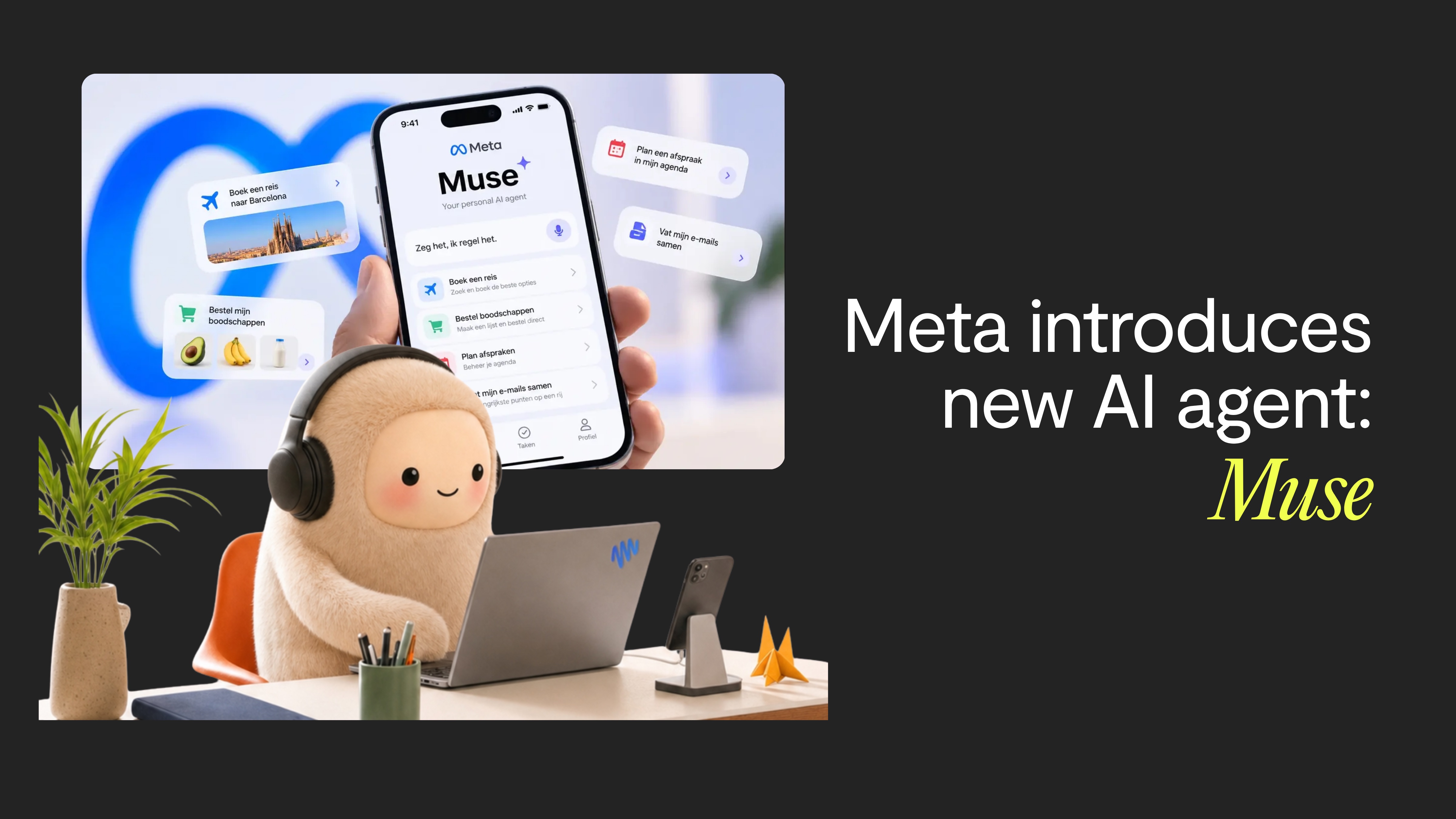
Yes. If your products are in Shopify Catalog and you ship to the US, Meta's new AI agent Muse can already find and buy your products today, using Shop Pay checkout, inside Instagram, WhatsApp or Facebook. Shopify switched this on by default on September 8, and Meta's side of the partnership went live on September 21.
Muse can browse a Shopify store and complete a purchase using a shopper's saved Shop Pay details, all inside a chat, without the shopper ever landing on your website. Shopify added Meta as an AI channel inside Shopify admin first, on September 8, then Shopify and Meta confirmed the partnership publicly two weeks later.
Why this matters. This is opt-out, not opt-in. Whether or not you're comfortable with an AI agent completing a checkout on your behalf, without you approving the specific product or price shown, is a decision that's already been made for you unless you go and change it.
Our take. GoodKarma's take: we're not telling clients to turn this off. We are telling them to know it's on, and to check what Muse actually shows when it pulls up their products, the same way you'd check how your brand looks on a marketplace you didn't build.
Why did my Shopify conversion rate suddenly change in late September?
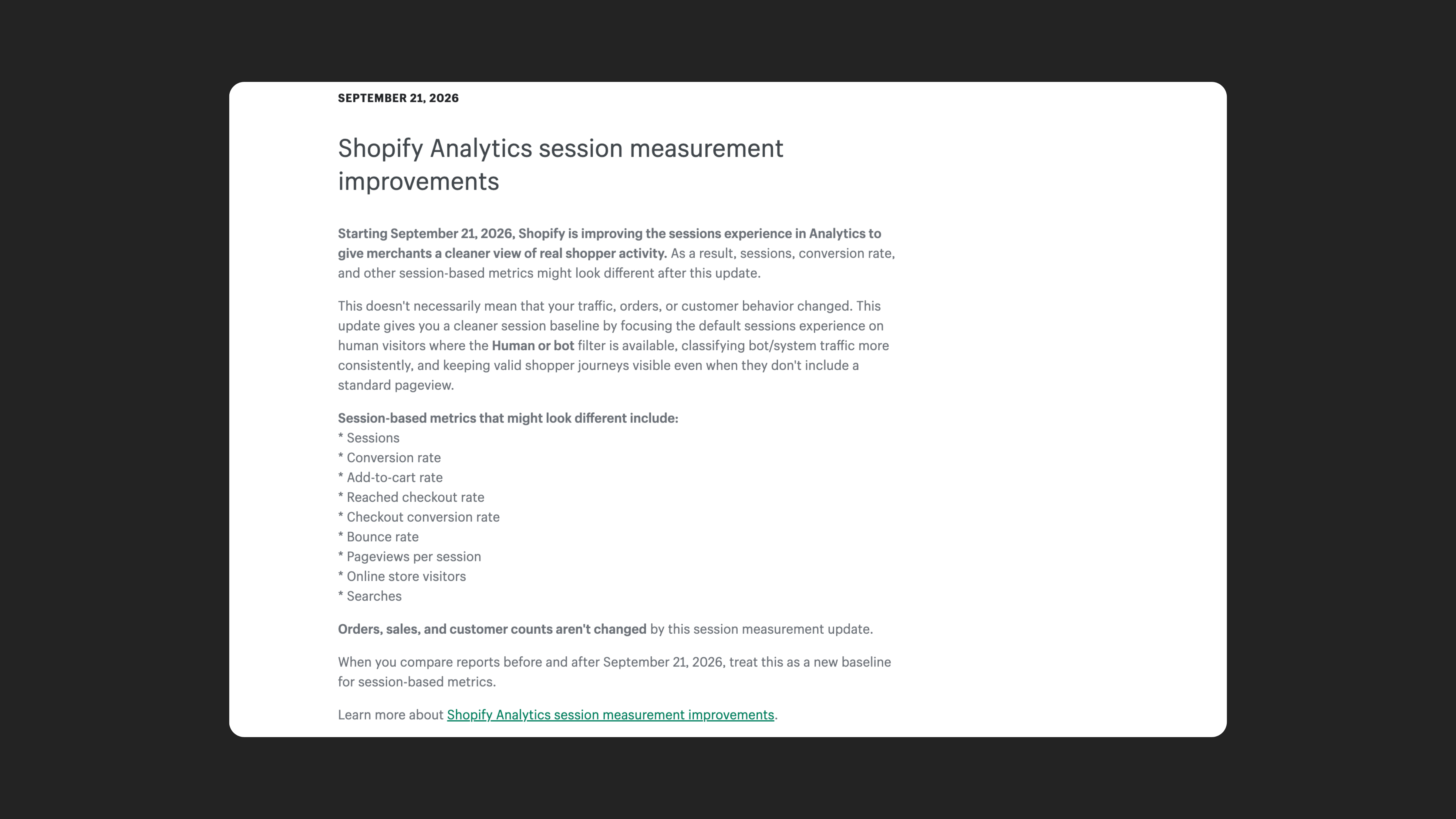
Between September 21 and 23, Shopify changed how it counts a website session: bot traffic is now filtered out by default, a session no longer splits in two at midnight UTC, and some visits without a normal pageview now count. Orders, sales and customer counts are unaffected. Only session-based metrics moved.
If your store gets meaningful bot traffic, removing it from the denominator alone can lift your reported conversion rate with nothing else changing. A store showing 100,000 sessions and 2,000 orders at a 2% conversion rate could show 90,000 sessions and the same 2,000 orders after the update, for a conversion rate that looks better without a single extra customer.
Why this matters. Anyone reporting Shopify performance to a boss, a board or a client needs to treat September 21, 2026 as a new baseline, not a date to smooth over in a month-over-month chart. A conversion rate jump right around that date is not automatically your new product page working.
Our take. GoodKarma's take: we're annotating every client report that spans this date, and we'd tell any ecommerce operator to do the same, whether that reporting goes to a boss, a board, or an agency partner like us. A platform change is not a marketing result, and mixing the two up costs credibility the next time a real result needs explaining.
On your roadmap
Is Anthropic's new commerce agent something I can actually use?
Not without a developer. On September 2, Anthropic released free, open-source code for a shopping agent and a merchant-operations agent, and Shopify already has working reference code built on it. It's a blueprint for a technical team to build from, not a feature you switch on in Shopify admin.
The shopping agent can search a catalog and build a cart from a plain-language request. The merchant agent is built for store operations: flagging stock about to run out, or drafting a markdown decision from sales history. Visa, Mastercard and Accenture are all building on the same open blueprint, alongside Shopify.
Why this matters. If you have in-house developers or a technical agency partner, this is worth a scoping conversation now, starting with the lower-risk option: a merchant-side tool for your own team, not a customer-facing shopping agent. If you don't have that kind of technical resource, there's nothing to do yet. Expect a packaged, no-code version of this to show up as a Shopify app within a few months, given who's already committed to building on it.
Our take. GoodKarma's take: this is a dev-and-agency job, not a merchant dashboard toggle, and that's exactly where a technical partner earns their retainer. We'd rather prototype the boring merchant-side version first, something that flags low stock automatically, than jump straight to a customer-facing agent nobody has tested.
Should I turn on Gorgias' AI agent for WhatsApp?
Gorgias' AI support agent, Gaia, can now verify a customer's identity and take real action instead of only answering questions, over SMS and WhatsApp, both added between September 8 and 18. For a Netherlands or EU-based brand, that's a bigger decision than it sounds, because WhatsApp is close to universal there, not a backup channel.
The Netherlands has the highest WhatsApp penetration in Europe, at roughly 98% of smartphone users, and many EU shoppers already expect to message a brand there rather than email. Putting an AI agent on WhatsApp for a Dutch or EU brand means putting it on a channel your customers may already treat as the main way they talk to you.
Why this matters. A US brand piloting Gaia on WhatsApp is testing a secondary channel. A Netherlands based brand doing the same thing is testing it on what might be its busiest channel. The stakes are different, even though the feature is identical.
Our take. GoodKarma's take: test this with a narrow set of questions, like order status or simple FAQs, and a fast, clear handover to a person. Don't treat it as a low-stakes pilot just because that's how it would work for a US brand. For most of our Dutch and European clients, WhatsApp already carries too much real volume for that.
Do Shopify's new speed improvements mean I don’t need to worry about optimising my site anymore?
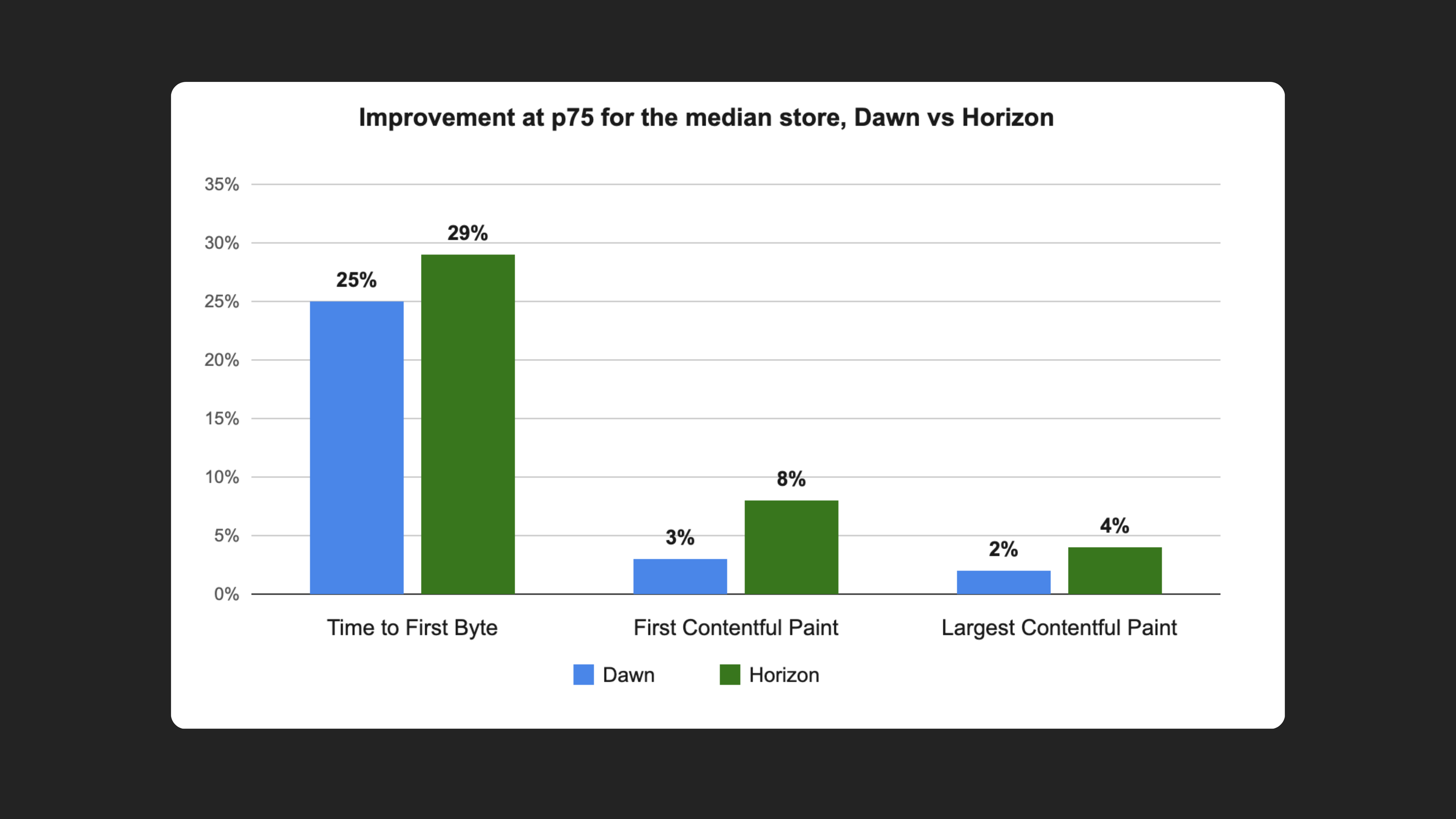
Not quite, but it’s making things easier. Shopify made every standard Liquid storefront load about 29% faster at typical load, with zero merchant action required, by changing how it streams a page to the browser. Most slow Shopify stores are actually slowed down by too many apps or bloated JavaScript, not by Liquid itself.
This follows earlier 2026 upgrades that also sped up standard Shopify storefronts automatically. Two of Shopify's own themes, Dawn and Horizon, both got faster from this change, but Horizon converted more of that speed into a faster-feeling page because its critical resources were better placed in the code. Platform speed and good theme development are two separate things that both matter.
Why this matters. "Our site is too slow, we need to go headless" used to be a reasonable argument on its own. It's a weaker one now, because raw platform speed is increasingly not the bottleneck a headless rebuild would actually fix.
Our take. GoodKarma's take: this doesn’t fully negate a reguar site speed audit and optimisation round, but the biggest win is often auditing the theme and app stack first. Be ruthless and get rid of apps faster then you install them.
Other Shopify and Klaviyo updates worth knowing
- WhatsApp opt-ins at checkout. Shopify can now capture WhatsApp marketing consent the moment someone completes a purchase, so you can legally start messaging customers there. Worth turning on if WhatsApp is part of your plan at all, especially for EU brands.
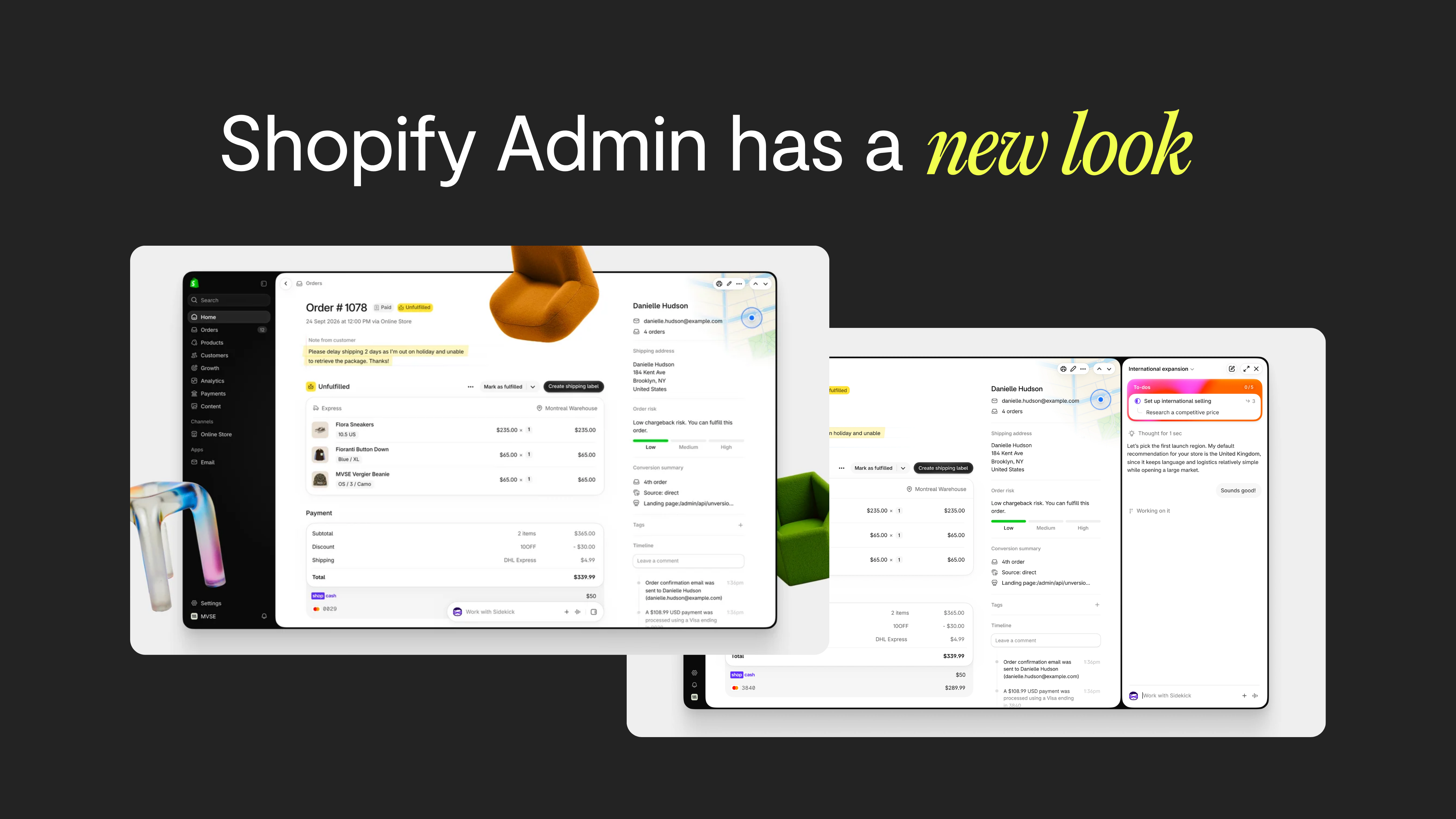
- Shopify admin redesign, and Sidekick everywhere. The admin got a full visual refresh between September 15 and 24, and Shopify's own AI assistant, Sidekick, now has a permanent chat box on every page instead of being tucked away. Shopify says daily Sidekick use grew 4.8 times year over year.
- Klaviyo send-time reports get a real baseline. Send-time analytics can now compare against a baseline you choose, like your last five sends, instead of just a generic average, making it easier to prove whether a specific change actually worked.
Next steps: September into October
- If your products have variants such as different colours or weight, don’t set them up as separate products; set them up as variants.
- Fill in return policy specifics under Settings > Policies, including an exact return window in days.
- Decide whether you want Meta's Muse buying from your store by default, and check your Agentic Storefronts settings if you want to change it.
- Annotate September 21, 2026 in any performance report that compares before and after that date.
- If you have technical resources, scope a low-risk internal use case for an AI merchant agent, like automatic low-stock flags.
- If you're considering a WhatsApp support pilot, start with a narrow set of questions and a fast handover to a human.
Frequently asked questions
Do I need to do anything about Shopify's AI shopping features right now? Only if your product data is incomplete. If colour, size and key specs are already set up as real Shopify variants, most of September's changes require no action. If they're not, an AI shopping assistant may already be skipping your products.
Is my Shopify conversion rate data still reliable after the September update? Yes, but compare it to itself going forward, not to data from before September 21, 2026. Orders, sales and customer counts weren't affected by the change, only session-based metrics like conversion rate and bounce rate.
Do I need to turn off Meta's Muse if I don't want AI agents buying from my store? Only if you're not comfortable with it. It's on by default for any Shopify store shipping to the US, and turning it off means changing your Agentic Storefronts settings, not waiting for an email to opt out.
Do we need a developer to prepare for any of this? For the catalog and settings checklist, no, most of it is admin-level work. For Anthropic's commerce agent blueprint specifically, yes, that one needs a developer or technical agency partner to build anything usable.
Talk to us
If you want a second opinion on what to prioritise before Black Friday, talk to GoodKarma.
Share on:


.png)