
The gap between strategy and creative has long plagued ecommerce brands. Companies either chase performance metrics without building lasting brand equity, or they create beautiful campaigns that fail to convert. This divide costs businesses millions in wasted ad spend and missed opportunities. For fast-growing ecommerce brands in fashion, beauty, and lifestyle sectors, mastering both disciplines isn't optional in 2026; it's the foundation of sustainable growth. The brands winning today understand that developing creative and media strategies requires equal parts data analysis and brand storytelling.
The False Choice Between Brand and Performance
Most ecommerce agencies force brands to choose between creative excellence and measurable results. Performance-focused agencies optimize every pixel for conversion but produce generic, forgettable experiences. Creative agencies build stunning visual identities that fail to drive revenue.
This creates a dangerous pattern. According to a 2025 study by Shopify, brands that prioritize only direct response see 34% lower customer lifetime value compared to those balancing brand-building with performance marketing. Fashion retailer Reformation demonstrated this perfectly when they restructured their approach in 2024, allocating 60% of budget to brand-building creative and 40% to conversion-focused tactics. The result? A 47% increase in new customer acquisition and 52% higher repeat purchase rates within eight months.
Why Strategy Without Creative Fails
Data-driven decisions mean nothing without compelling execution. You can identify the perfect audience segment, craft the ideal messaging framework, and select optimal channels. But if your creative doesn't stop the scroll, none of it matters.
Consider these benchmarks from Meta's 2025 Ecommerce Report:
- Average click-through rate for generic product ads: 0.89%
- CTR for strategically developed creative assets: 2.34%
- Conversion rate improvement with brand-consistent creative: 67%
Beauty brand Glossier rebuilt their performance marketing in late 2024 by implementing what they called "strategic creative systems." Rather than testing random ad variations, they developed a creative framework rooted in brand values and customer insights, then systematically tested execution variations. Their cost per acquisition dropped 41% while maintaining the premium brand perception that commands their pricing power.
Why Creative Without Strategy Wastes Budget
Equally dangerous is beautiful creative disconnected from business objectives. Lifestyle brand Parachute learned this lesson after spending $340,000 on a stunning brand campaign that generated millions of impressions but converted at half their normal rate. The creative was visually perfect but failed to address customer pain points or guide viewers toward purchase.
Building Your Strategy and Creative Foundation
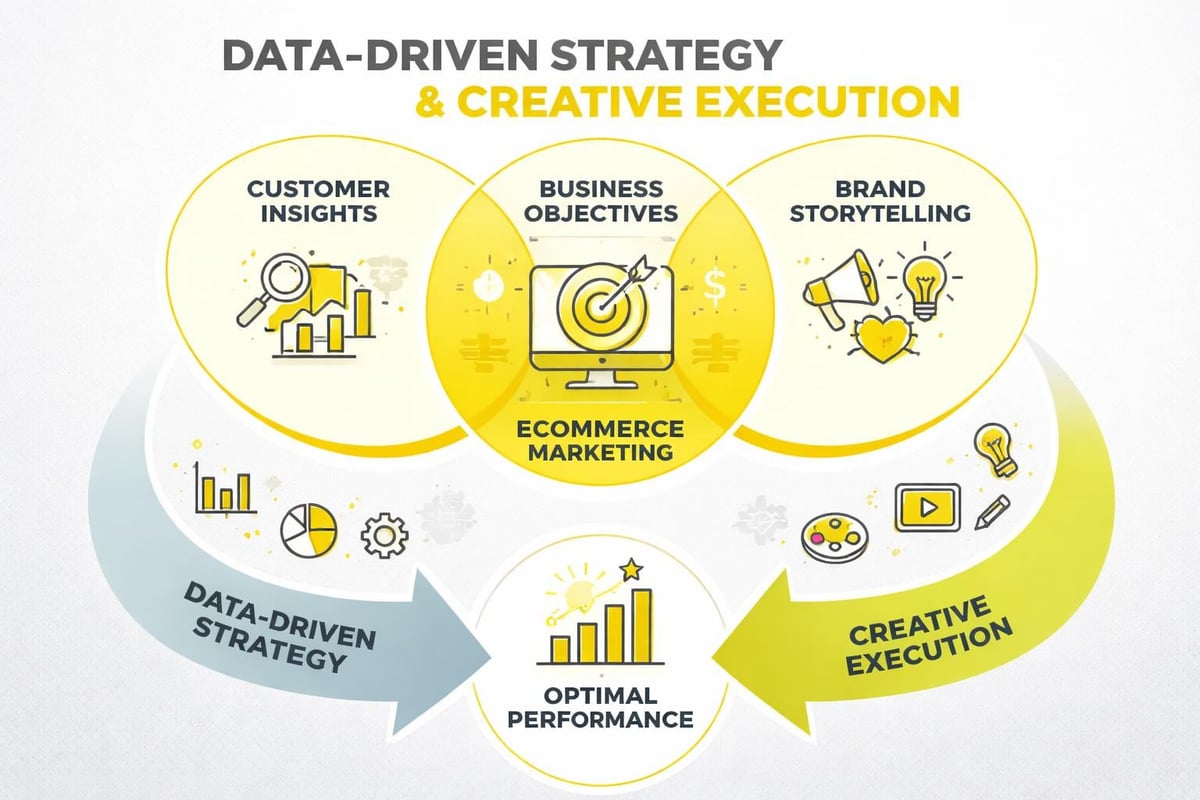
Successful integration of strategy and creative starts with a structured framework. This isn't about compromising on either discipline. It's about creating a system where both inform and strengthen each other.
Step 1: Establish Your Strategic Pillars
Begin by documenting your core strategic parameters:
Business Objectives
- Revenue targets by quarter
- Customer acquisition cost thresholds
- Lifetime value goals
- Market share ambitions
Audience Insights
- Demographic and psychographic profiles
- Purchase behavior patterns
- Content consumption habits
- Pain points and desires
Competitive Positioning
- Direct competitor analysis
- Category trends and white space
- Pricing strategy implications
- Differentiation opportunities
Home goods brand Snowe executed this process in Q1 2025 before launching their spring collection. They identified that their target customer (women 28-42, household income $85K+) consumed content primarily on Instagram and Pinterest between 8-10 PM, valued sustainability messaging, but converted best on product quality and versatility claims. This strategic foundation informed every creative decision that followed.
Step 2: Develop Your Creative Framework
Your creative framework should translate strategy into executable guidelines without stifling creativity. Understanding marketing strategy provides the foundation, but implementation requires specific creative parameters.
| Framework Element | Strategic Input | Creative Output |
|---|---|---|
| Visual Identity | Brand positioning, competitor analysis | Color palettes, typography, photography style |
| Messaging Hierarchy | Customer insights, value propositions | Headlines, body copy, calls-to-action |
| Content Formats | Platform behavior, audience preferences | Video length, image ratios, carousel strategies |
| Brand Voice | Customer psychographics, differentiation | Tone, vocabulary, storytelling approach |
Wellness brand Vital Proteins restructured their creative process using this framework in 2024. Rather than creating ad-hoc assets, they established clear creative parameters that allowed designers and copywriters to move quickly while maintaining strategic alignment. Production time decreased 58% while campaign performance improved 33%.
Step 3: Create Your Testing Architecture
Strategy and creative optimization requires systematic testing, not random experimentation. Build a testing framework that generates insights you can actually use.
Creative Testing Hierarchy:
Concept Testing (Test big ideas against each other)
- Different value propositions
- Contrasting emotional appeals
- Varied product positioning
Execution Testing (Test variations within winning concepts)
- Visual styles and treatments
- Messaging frameworks
- Format and length variations
Optimization Testing (Refine winning executions)
- Headline variations
- Call-to-action phrasing
- Color and design tweaks
Fashion brand Everlane applies this hierarchy religiously. They start every campaign by testing 3-4 distinct concepts against their control. The winning concept moves to execution testing with 5-6 variations. The top performer enters continuous optimization. This systematic approach helped them achieve a 2.8% average conversion rate in 2025, nearly double the industry benchmark of 1.5% for fashion ecommerce.
Platform-Specific Strategy and Creative Integration
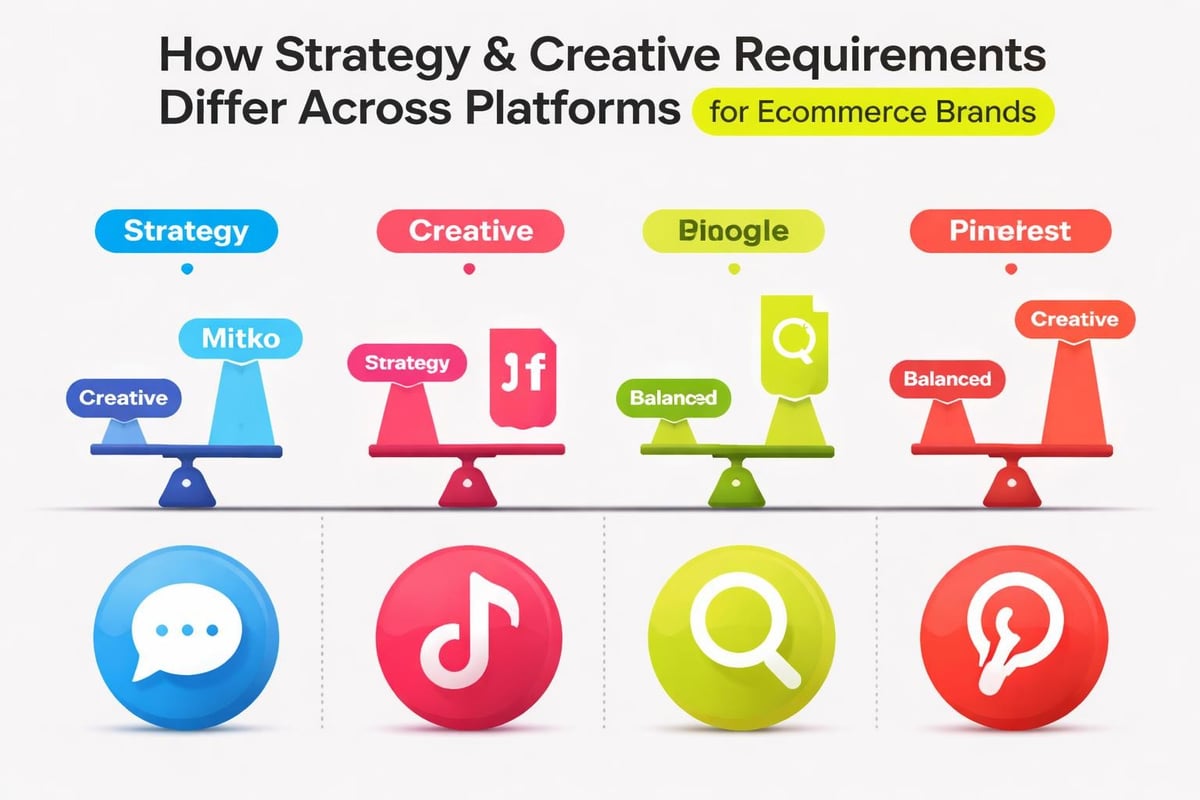
Different platforms demand different balances of strategy and creative. Success requires understanding each channel's unique dynamics while maintaining brand consistency.
Meta (Facebook and Instagram)
Meta platforms reward thumb-stopping creative backed by precise targeting strategy. The algorithm optimizes delivery, but your strategy and creative determine whether you're worth showing.
Strategic Requirements:
- Audience segmentation based on purchase stage
- Budget allocation across awareness and conversion
- Retargeting architecture and frequency management
Creative Imperatives:
- First-frame hook within 0.5 seconds
- Mobile-first vertical formats
- Clear value proposition within 3 seconds
Beauty brand Charlotte Tilbury demonstrates masterful creative strategy on Meta. Their Q4 2025 holiday campaign used strategic audience segmentation (new customers, past purchasers, high-value VIPs) with creative variations tailored to each segment. New customers saw educational content about product benefits. Past purchasers received exclusive offers on complementary products. VIPs got early access messaging. The result? A 94% increase in holiday revenue compared to 2024.
TikTok
TikTok punishes overly polished advertising and rewards authentic, entertaining content. Your strategy must embrace this reality while still driving business results.
Create a content strategy that balances:
- Native, user-generated style content (60%)
- Product-focused educational content (25%)
- Direct response promotional content (15%)
Skincare brand CeraVe exploded on TikTok by understanding this balance. Their strategy targeted skincare enthusiasts and dermatology students, but their creative looked nothing like traditional beauty advertising. They created content that felt like helpful tips from a friend, not sales pitches. When dermatologists organically started recommending their products, CeraVe amplified these authentic moments rather than creating polished brand content. Sales increased 71% year-over-year in 2025.
Google (Search and Shopping)
Google rewards strategic keyword targeting and clear, benefit-focused creative. The search intent is already present, so your strategy and creative must quickly demonstrate relevance and value.
Search Campaign Strategy:
- Intent-based keyword grouping
- Landing page alignment with search terms
- Bid strategy based on customer value
Creative Best Practices:
- Headlines that mirror search intent
- Specific benefits and differentiators
- Strong, clear calls-to-action
Home decor brand Burrow rebuilt their Google strategy in 2024 by creating tightly themed ad groups with hyper-relevant creative. Instead of generic "modular sofa" ads, they created separate campaigns for "small apartment sofa," "pet-friendly couch," and "easy-move furniture," each with landing pages and ad creative specifically addressing that search intent. Conversion rates improved 127% while cost per acquisition decreased 34%.
Pinterest users plan purchases weeks or months in advance. Your strategy should focus on inspiration and aspiration, with creative that fits seamlessly into boards and planning.
Lifestyle brand West Elm treats Pinterest as a long-term brand-building channel where strategy and creative work together to inspire future purchases. Their 2025 approach included:
- Seasonal content calendars aligned with planning cycles
- Shoppable pins with clear product information
- Room inspiration content linking to specific products
- How-to content demonstrating product versatility
This strategic approach to Pinterest generated a 43% increase in referred traffic and 38% higher average order values compared to other channels, as customers arrived further along in their purchase journey.
Email Marketing: Where Strategy and Creative Converge
Email represents the perfect marriage of strategy and creative for ecommerce brands. You control the entire experience, can precisely segment audiences, and have unlimited creative freedom.
Strategic Email Framework
Build your email strategy around customer lifecycle stages:
Welcome Series (Days 1-14)
- Strategic goal: Brand education and first purchase
- Creative focus: Brand story and value proposition
- Expected conversion: 8-12% of recipients
Engagement Series (Ongoing)
- Strategic goal: Content consumption and consideration
- Creative focus: Lifestyle content and product education
- Expected engagement: 25-35% open rates
Conversion Series (Purchase triggers)
- Strategic goal: Drive immediate purchases
- Creative focus: Urgency, scarcity, and offers
- Expected conversion: 15-25% of recipients
Retention Series (Post-purchase)
- Strategic goal: Repeat purchases and loyalty
- Creative focus: Exclusive access and appreciation
- Expected repeat rate: 30-40% within 90 days
Fashion brand Reformation's email program exemplifies strategic creative excellence. Their welcome series tells the sustainability story while showcasing best-sellers. Engagement emails share styling tips and behind-the-scenes content. Conversion emails create urgency around limited inventory. Retention emails offer early access to VIP customers. This strategic framework with creative execution tailored to each stage generates 38% of their total revenue.
Creative Email Excellence
Strong email creative requires balancing brand consistency with fresh ideas. Advertising management principles apply directly to email creative development.
Design Best Practices:
- Mobile-first layouts (73% of emails opened on mobile in 2025)
- Scannable hierarchy with clear focal points
- Strategic white space and breathing room
- Consistent brand elements without repetitive templates
Copy Best Practices:
- Subject lines under 50 characters (68% higher open rates)
- Benefit-focused headlines that promise value
- Conversational tone aligned with brand voice
- Clear, singular calls-to-action
Health and wellness brand Vital Proteins tested email creative approaches in 2025 and found that lifestyle-focused creative (showing products in use) converted 47% better than product-focused creative (showing products on white backgrounds), despite the latter performing better on social media. This illustrates why strategy and creative must adapt to each channel's unique context.
Shopify: The Platform for Strategic Creative Excellence
Platform choice directly impacts your ability to execute integrated strategy and creative. Shopify has emerged as the clear leader for brands serious about balancing brand-building with performance marketing.
Why Shopify Enables Better Strategy and Creative
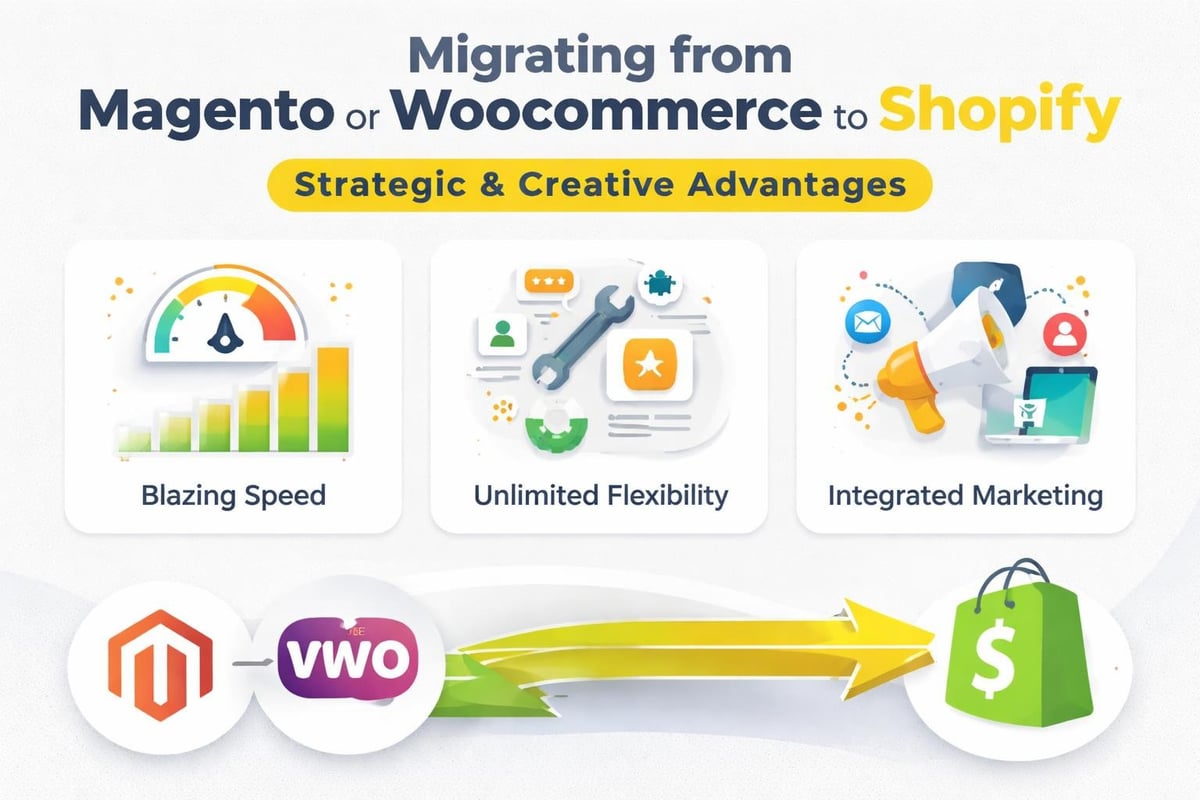
Speed to Market Shopify's infrastructure allows rapid creative testing and implementation. Beauty brand Glossier can test new landing pages in hours, not weeks. This speed enables more strategic testing and faster creative optimization.
Design Flexibility Unlike WooCommerce's template limitations or Magento's complexity, Shopify offers the perfect balance of design freedom and performance optimization. Fashion brands like Allbirds create unique, branded experiences without sacrificing site speed or conversion optimization.
Integrated Marketing Stack Shopify's native integration with Meta, Google, TikTok, and email platforms creates seamless data flow. This integration enables sophisticated strategy and creative personalization impossible on fragmented platforms.
| Platform Feature | Shopify | Magento | WooCommerce |
|---|---|---|---|
| Design Flexibility | Excellent | Good | Limited |
| Speed to Market | Days | Weeks | Weeks |
| Native Marketing Integration | Excellent | Limited | Limited |
| Performance Optimization | Built-in | Manual | Manual |
| Creative Testing Tools | Native | Third-party | Third-party |
Real-World Shopify Migration Results
Premium denim brand DL1961 migrated from Magento to Shopify in 2024. The strategic driver was speed: they needed to test creative faster and implement optimization quicker. Results within six months:
- Time to launch new creative: reduced from 3 weeks to 2 days
- A/B testing velocity: increased from 8 tests/month to 47 tests/month
- Site speed improvement: 67% faster load times
- Conversion rate increase: 34% improvement
- Revenue growth: 52% year-over-year
Wellness brand Olly made the same migration, prioritizing creative flexibility. On Magento, design changes required developer intervention and weeks of work. On Shopify, their marketing team could implement creative updates in hours. This creative agility allowed them to capitalize on trending topics and seasonal moments, contributing to 89% revenue growth in their first year on Shopify.
Building Your Strategy and Creative Team
The right team structure determines whether strategy and creative actually integrate or remain siloed functions fighting for budget and priority.
Internal Team Structure
Option 1: Integrated Team Model Create cross-functional pods that include strategists, designers, copywriters, and analysts working together on specific campaigns or channels.
Pros:
- Natural strategy and creative collaboration
- Faster decision-making and iteration
- Shared accountability for results
Cons:
- Requires larger team size
- Potential skill redundancy
- Complex resource management
Option 2: Functional Teams with Integration Points Maintain separate strategy and creative teams with structured collaboration processes.
Pros:
- Specialized skill development
- Efficient resource allocation
- Clear functional leadership
Cons:
- Requires disciplined process
- Risk of siloed thinking
- Slower iteration cycles
Beauty brand Glow Recipe uses the integrated pod model with teams organized by channel (Meta, Google, Email, etc.). Each pod includes a strategist, creative lead, copywriter, and performance analyst. This structure enabled them to increase testing velocity by 340% in 2025 while maintaining creative consistency across channels.
Agency Partnership Model
Many fast-growing brands lack the resources to build complete in-house teams. Strategic agency partnerships can provide integrated strategy and creative expertise.
Look for agencies that:
- Demonstrate both strategic rigor and creative excellence
- Show measurable performance results, not just pretty work
- Understand ecommerce-specific metrics and optimization
- Have deep platform expertise (especially Shopify)
- Provide integrated services across channels
Home goods brand Parachute partnered with a specialized ecommerce agency in 2024 after struggling to balance internal strategy and creative functions. The agency's integrated approach increased their ROAS from 3.2x to 5.7x while improving brand perception scores by 28 points.
Measuring Strategy and Creative Performance
You can't optimize what you don't measure. Successful brands track both immediate performance metrics and long-term brand health.
Performance Metrics (Short-term)
Track these metrics by campaign, channel, and creative variation:
- Click-Through Rate (CTR): Measures creative stopping power
- Conversion Rate (CVR): Measures strategic relevance and creative persuasiveness
- Cost Per Acquisition (CPA): Measures overall efficiency
- Return on Ad Spend (ROAS): Measures revenue impact
- Average Order Value (AOV): Measures customer quality and upsell effectiveness
Set benchmarks by industry and channel. Fashion ecommerce averaged these metrics in Q4 2025:
- Meta CTR: 1.84%
- Meta CVR: 2.1%
- Google Shopping CVR: 3.4%
- Email CVR: 4.7%
Brand Metrics (Long-term)
Balance performance metrics with brand health indicators:
- Aided Brand Awareness: Percentage who recognize your brand
- Unaided Brand Awareness: Percentage who mention your brand unprompted
- Brand Consideration: Percentage who would consider purchasing
- Net Promoter Score (NPS): Customer satisfaction and loyalty
- Search Volume: Branded search trends over time
Activewear brand Outdoor Voices tracks both sets of metrics monthly. When performance campaigns started eroding brand metrics in 2024 (NPS dropped 14 points over three months), they rebalanced their budget allocation. By investing 55% in brand-building creative and 45% in direct response, they recovered brand metrics while actually improving long-term customer acquisition costs.
Common Strategy and Creative Mistakes to Avoid
Even sophisticated brands make predictable mistakes when integrating strategy and creative. Awareness prevents waste.
Mistake 1: Testing Too Many Variables
Brands often test creative variations that change multiple elements simultaneously, making it impossible to identify what drove results. Test one variable at a time: concept, then execution, then optimization.
Mistake 2: Ignoring Creative Fatigue
Meta and TikTok creative fatigues quickly. Fashion brand Everlane found their creative performance drops 40% after 2-3 weeks of continuous use. Build creative refresh into your strategic planning, not as an afterthought when performance declines.
Mistake 3: Misaligning Creative with Landing Pages
Your ad creative makes promises. Your landing page must deliver on those promises with consistent messaging, visuals, and offers. Beauty brand Fenty Beauty tested identical ad creative with different landing pages in 2025. The aligned experience converted at 4.3% while the misaligned version converted at 1.7%.
Mistake 4: Neglecting Platform Context
What works on Instagram fails on TikTok. What converts in email falls flat in paid search. Adapt your strategy and creative to each platform's unique context and user expectations.
Mistake 5: Choosing Platform Over Strategy
Don't build your strategy around platform capabilities. Define your strategic objectives first, then select platforms and creative approaches that serve those objectives. Home brand Burrow wasted six months forcing TikTok to work because "everyone's on TikTok" before admitting Pinterest and Google better served their customer journey and business model.
Advanced Strategy and Creative Techniques
Once you've mastered the fundamentals, advanced techniques can further optimize performance.
Dynamic Creative Optimization (DCO)
Let platforms automatically test creative combinations. Provide multiple headlines, images, descriptions, and calls-to-action. The algorithm identifies winning combinations and scales them.
Fashion brand ASOS tested DCO versus manual optimization in 2025. DCO improved ROAS by 23% by finding creative combinations human strategists hadn't considered.
Predictive Creative Testing
Use historical performance data to predict creative success before spending significant budget. Machine learning models can analyze creative elements and estimate performance based on past results.
Creative Sequencing
Show different creative messages based on customer journey stage. First-time viewers see awareness creative. Engaged users see consideration creative. Cart abandoners see conversion creative. This strategic sequencing improves efficiency 35-60% versus static approaches.
Beauty brand Tatcha implemented creative sequencing in late 2025. New audiences saw educational content about Japanese skincare rituals. Engaged users received product-specific benefits. Previous customers got exclusive offers. This strategic approach reduced CPA by 42% while increasing customer lifetime value by 31%.
Mastering the balance between strategy and creative isn't just about better marketing; it's about building a sustainable competitive advantage in an increasingly crowded ecommerce landscape. The brands winning in 2026 understand that data without creativity is boring, and creativity without strategy is wasteful. If you're ready to bridge this gap and unlock profitable growth for your ecommerce brand, Good Karma Agency specializes in walking this fine line between brand-building and performance optimization across Shopify design, development, and integrated marketing channels.


