
The ecommerce world is moving fast, and every retailer faces new challenges as 2026 approaches. Adapting to these shifts is not optional, it is essential for growth.
This guide walks you through how to choose, collaborate with, and excel alongside an ecommerce software development company. You will discover the latest must-have platform features, practical evaluation steps, project planning tips, integration strategies, and proven case studies from top brands in fashion, beauty, health, and home.
Ready to future-proof your business? Dive in and get actionable insights that help you thrive in a rapidly changing digital marketplace.
The Ecommerce Software Landscape in 2026
The ecommerce software landscape in 2026 is undergoing rapid transformation. Customer expectations are higher than ever, and brands must adapt to remain competitive. Choosing the right ecommerce software development company is now a strategic necessity, not just a technical decision.

Key Trends Shaping Ecommerce Software
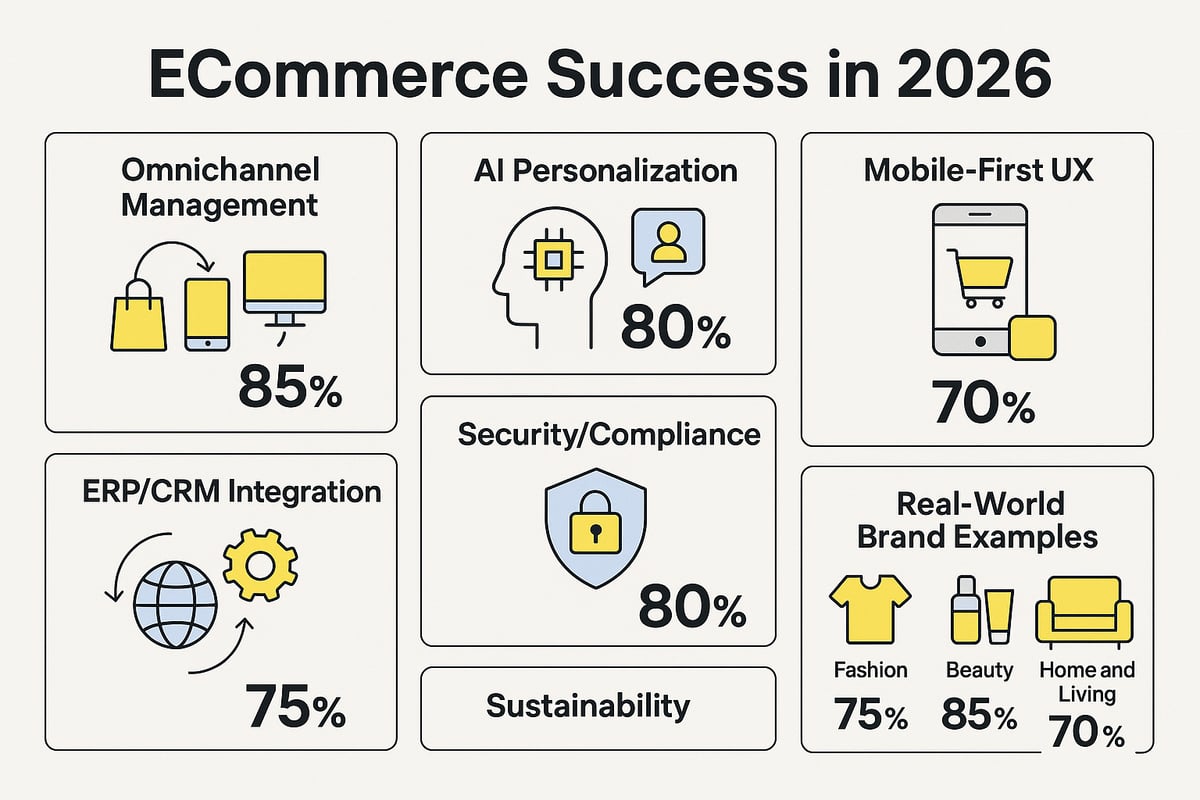
In 2026, several trends are reshaping what brands demand from an ecommerce software development company. AI-driven personalization and automation are now foundational, with 80% of brands leveraging AI for product recommendations, dynamic pricing, and customer support. Omnichannel commerce is standard: customers expect to shop seamlessly across web, mobile, social, and even physical stores.
Headless commerce adoption is accelerating, with 60% of fast-growing brands moving to flexible, API-driven architectures. This shift enables rapid deployment of new channels and experiences. Mobile-first design and progressive web apps (PWAs) dominate, as over 70% of ecommerce traffic now comes from mobile devices (Statista, 2025).
Sustainability is a must-have. Features like carbon tracking at checkout, eco-friendly logistics, and transparent supply chains are now table stakes. Security and compliance are equally critical, with GDPR, CCPA, and new data privacy regulations shaping development roadmaps. Composable commerce and modular tech stacks allow brands to build, test, and iterate faster than ever.
Here’s a snapshot of how these trends compare:
| Trend | 2026 Adoption Rate | Example Benefit | Real-World Example |
|---|---|---|---|
| AI Personalization | 80% | +30% average order value | Sephora, AG1 |
| Headless Commerce | 60% | 2x faster channel expansion | Daily Paper |
| Mobile-First/PWAs | 70%+ | +25% conversion on mobile | IKEA, Brand X |
| Omnichannel Integration | 85% | Unified inventory & CX | AG1 |
| Sustainability Features | 65% | Higher loyalty, NPS | Allbirds, IKEA |
| Enhanced Security/Compliance | 90% | Fewer breaches, trust | Global D2C brands |
For a deeper dive into these developments, see the Top Ecommerce Trends to Watch in 2026. These trends should be at the core of your conversations with any ecommerce software development company.
Industry-Specific Innovations
To succeed in 2026, an ecommerce software development company must deliver tailored solutions for each industry.
Fashion brands are embracing virtual try-ons and AI-powered styling, which boost customer engagement and reduce returns. Daily Paper’s Shopify Plus migration enabled multi-country expansion with localized experiences and AR try-on features.
Beauty companies leverage AR makeup applications and personalized quizzes. Sephora, for example, uses AI to recommend products based on skin tone and preferences, driving higher conversion rates and basket sizes.
Health & Wellness brands integrate subscription models and telehealth services. AG1’s use of automated email workflows and subscription management increased recurring revenue and improved retention.
Home & Living retailers deploy 3D product visualization and augmented reality room planners. IKEA’s investment in mobile-first AR tools allows customers to place furniture virtually, enhancing confidence and reducing purchase hesitation.
Brands in each sector should ask their ecommerce software development company for proven results—case studies, user adoption metrics, and examples of industry-specific features in action. This ensures your ecommerce platform is not only current but future-ready.
How to Choose the Right Ecommerce Software Development Company
Selecting the right ecommerce software development company can make or break your digital transformation. With industry giants like Sephora and IKEA setting high standards, a strategic approach is essential. Below is a step-by-step process to ensure your partnership is set up for long-term success.
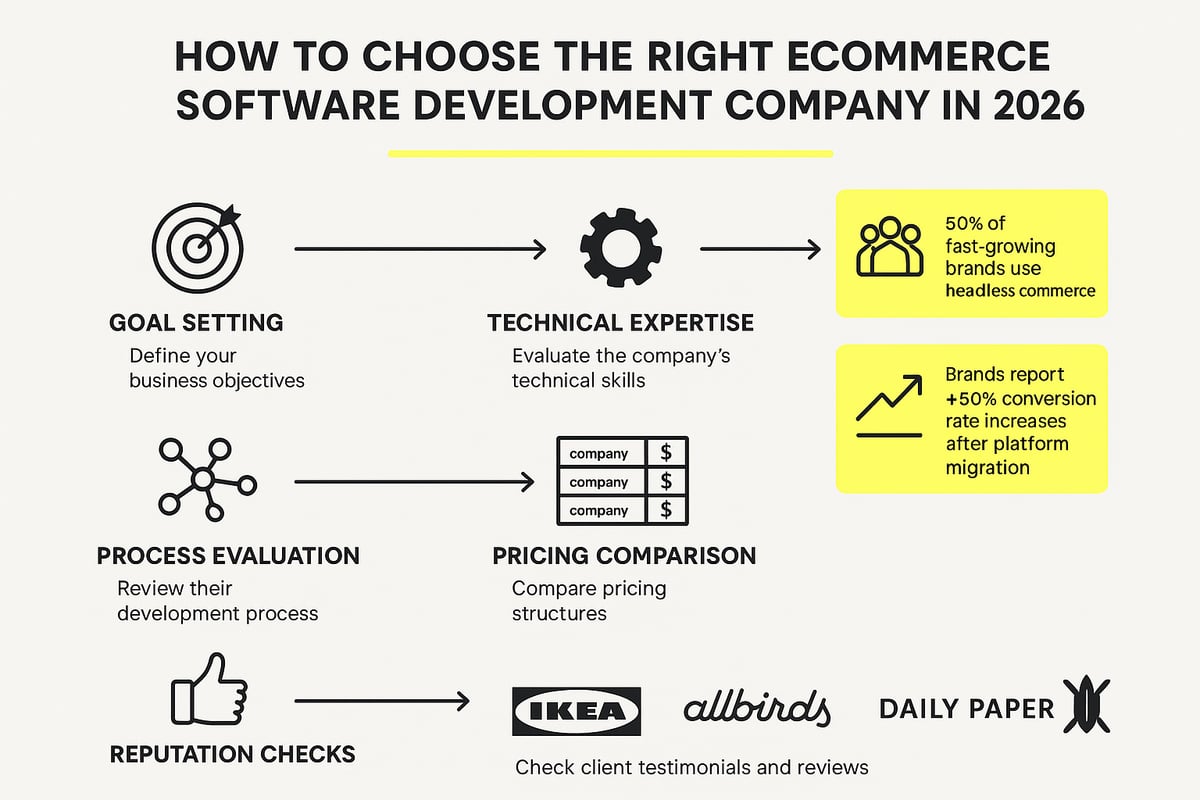
Step 1: Define Your Business Goals and Technical Needs
Start by mapping your business priorities. Do you plan to expand globally, boost conversion rates, or launch new channels? Document both short-term and long-term objectives. Identify essential integrations, such as ERP and CRM, that will streamline your operations. For example, health and wellness brands often prioritize subscription models and telehealth integrations. Fashion retailers, like Daily Paper, focus on multi-country rollouts. By clarifying your requirements, you set a strong foundation for selecting an ecommerce software development company that aligns with your vision.
Step 2: Evaluate Technical Expertise and Platform Specialization
Assess the technical strengths of your potential partner. Are they experienced with Shopify Plus, Magento, or custom headless builds? Review their case studies, especially those in your sector. For instance, Filling Pieces’ migration to Shopify resulted in faster site speed and increased sales. Ensure the team is up-to-date on AI, AR/VR, and composable commerce. For a detailed overview of services and platform expertise, explore their Ecommerce development services overview. This step is crucial for finding a company that matches your technology stack and growth ambitions.
Step 3: Assess Process, Communication, and Support
A transparent, agile process is vital. Look for an ecommerce software development company that uses agile methodologies, enabling fast iterations and adaptability. Transparent project management, with regular updates and accessible dashboards, keeps stakeholders informed. Ongoing support and optimization distinguish top-tier partners. For example, beauty brands like Sephora benefit from continuous feature rollouts and real-time site monitoring. Effective communication ensures your team and the development company are always aligned.
Step 4: Compare Pricing Models and ROI
Understanding pricing structures helps you budget effectively. Common models include fixed price, time & materials, and retainer. Here’s a comparison:
| Model | Best For | Example Use Case |
|---|---|---|
| Fixed Price | Defined scope | Shopify migration for fashion |
| Time & Materials | Evolving requirements | Headless build for lifestyle |
| Retainer | Ongoing optimization | CRO for beauty or wellness |
Review ROI from similar projects. Brands like Allbirds have seen +50% conversion rate increases post-migration. Choose a model that supports your roadmap and growth targets.
Step 5: Verify Reputation and Client Feedback
Reputation speaks volumes. Investigate testimonials, independent reviews, and industry awards. Request references from brands in your sector. For example, home and living companies look for partners with proven 3D visualization expertise, while lifestyle brands prioritize rapid rollout experience. Look for evidence of successful partnerships, not just technical delivery. This due diligence helps you avoid costly missteps and ensures your ecommerce software development company is trusted by industry peers.
Step 6: Ensure Cultural and Strategic Alignment
Shared values are essential for a productive partnership. Assess if the ecommerce software development company understands your brand’s creative vision and commitment to data-driven growth. Leading brands like IKEA and Sephora thrive by working with partners who act as true collaborators, not just vendors. Evaluate their willingness to innovate, adapt, and grow with your business. A cultural and strategic fit sets the stage for ongoing success and digital agility.
Essential Features and Capabilities for Ecommerce Success in 2026
Ecommerce is evolving at lightning speed, and brands that want to thrive in 2026 must build on a foundation of robust, adaptable technology. Choosing the right ecommerce software development company is the first step in unlocking next-generation features that drive growth, efficiency, and customer loyalty.
Core Ecommerce Platform Features
A future-ready ecommerce software development company delivers platforms that integrate seamlessly across channels. Omnichannel inventory and order management lets brands like Daily Paper operate in multiple countries without friction. Advanced search and filtering, paired with AI-driven merchandising, ensure shoppers find what they want quickly.
Mobile-first experiences are essential, as over 70% of ecommerce traffic is mobile. Progressive web apps (PWAs) guarantee lightning-fast page loads and app-like usability. Leading agencies leverage Shopify solutions for brands to build scalable storefronts with built-in AI personalization and product discovery.
To implement these features:
- Choose a platform that supports omnichannel workflows.
- Prioritize advanced search and recommendation engines.
- Demand mobile-optimized, PWA-ready design from your ecommerce software development company.
Integrations and Automation
Integrations and automation are at the heart of ecommerce efficiency. Your ecommerce software development company should connect your platform to ERP, CRM, marketing automation, and analytics systems. This enables real-time inventory sync, personalized marketing, and data-driven decision-making.
Social commerce integrations, such as TikTok Shop and Instagram Shopping, are vital for reaching new audiences. Automated fulfillment and returns management speed up operations and improve customer satisfaction. Brands like AG1 use advanced automation to grow email revenue by over 300%.
Step-by-step:
- List all business-critical integrations.
- Ensure your ecommerce software development company has expertise in API connectivity.
- Automate repetitive tasks and monitor results for continuous improvement.
Security, Compliance, and Accessibility
Security and compliance are non-negotiable for modern ecommerce. Your ecommerce software development company must implement multi-factor authentication, PCI DSS compliance, and GDPR/CCPA-ready data management. Accessibility is equally important, with WCAG 2.2 as the benchmark for inclusive design.
A robust security posture protects both the business and its customers. Sephora, for example, invests heavily in data protection and accessibility, ensuring all users can shop confidently.
To achieve this:
- Schedule regular security audits with your ecommerce software development company.
- Verify that all compliance checklists are met before launch.
- Test your storefront for accessibility using industry standards.
Sustainability and Social Responsibility Tools
Sustainability is now a deciding factor for many shoppers. An innovative ecommerce software development company will build in features like carbon footprint calculators at checkout, as seen with Allbirds, and integrate donation or give-back programs.
Transparent supply chains, eco-friendly logistics, and ethical sourcing are becoming standard. These capabilities not only appeal to conscious consumers but also future-proof your brand against regulatory changes.
Action steps:
- Request sustainability features during project scoping.
- Integrate environmental and social responsibility tools that align with your brand values.
- Track and report on sustainability metrics to engage your audience.
Real-World Examples
The most successful brands partner with an ecommerce software development company that understands their industry’s unique needs. Daily Paper’s multi-country Shopify Plus rollout enabled rapid growth in fashion. Sephora’s AI-powered product recommendations drive conversion in beauty. IKEA’s 3D room planners transform home and living ecommerce.
A summary table helps illustrate the impact:
| Sector | Brand | Key Feature | Result |
|---|---|---|---|
| Fashion | Daily Paper | Omnichannel Shopify Plus | Seamless global expansion |
| Beauty | Sephora | AI personalization | Higher conversion rates |
| Home & Living | IKEA | 3D/AR visualization | Increased customer engagement |
| Health & Wellness | AG1 | Automation & CRM | +326% email revenue |
The right ecommerce software development company will tailor solutions to your goals, ensuring your brand is set for success in 2026 and beyond.
Step-by-Step Ecommerce Software Development Process
Navigating a successful ecommerce transformation requires a structured, proven process. Whether you are launching a new storefront or replatforming for scale, partnering with an ecommerce software development company ensures your project stays on track and leverages the latest technology. Here is a concrete, actionable breakdown of each phase, with real-world examples from leading industries.
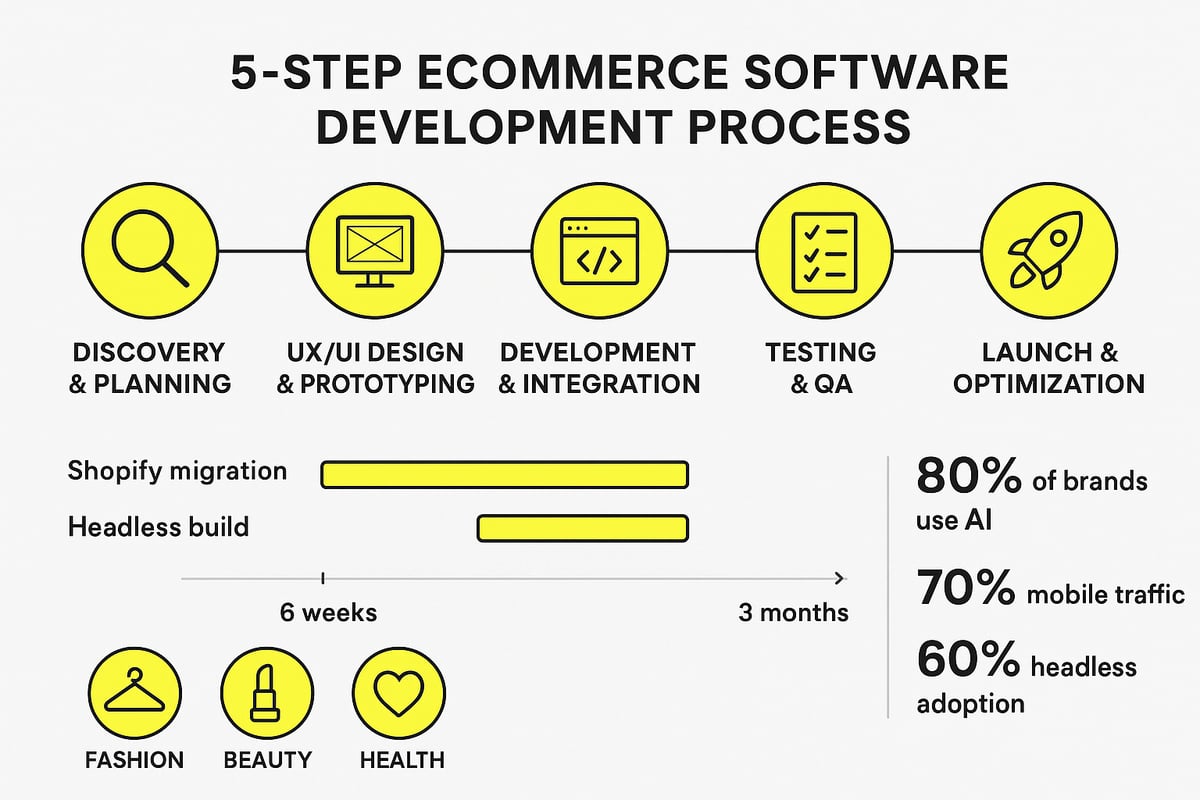
Step 1: Discovery & Planning
Every successful ecommerce initiative starts with a thorough discovery phase. An ecommerce software development company will organize stakeholder workshops to clarify your business objectives and technical requirements. For example, a global fashion brand might prioritize multi-currency support, while a wellness retailer could focus on subscription management.
Key actions include:
- Mapping user journeys to identify friction points
- Conducting technical scoping for integrations (ERP, CRM, payment gateways)
- Benchmarking competitors for feature gaps
In 2025, Daily Paper’s multi-country rollout began with deep market research and competitive analysis. This planning phase ensures the ecommerce software development company aligns its solutions with your sector’s challenges and growth targets.
Step 2: UX/UI Design & Prototyping
Once requirements are clear, the focus shifts to user experience. The ecommerce software development company crafts wireframes and interactive prototypes reflecting your brand identity. For beauty retailers, this might mean designing AR-powered virtual try-ons, while home brands could prioritize 3D room planners.
Actionable steps:
- Build brand-aligned design systems for consistency
- Develop interactive prototypes for stakeholder feedback
- Conduct user testing with real customers
Sephora’s digital transformation is a prime example. Their ecommerce software development company used iterative prototyping and A/B testing to refine personalized recommendations, resulting in increased engagement.
Step 3: Development & Integration
With designs approved, development begins. The ecommerce software development company utilizes agile sprints to build both frontend and backend components. API integrations are essential for ERP, CRM, inventory, and marketing automation.
Process highlights:
- Set up headless or composable architecture for flexibility
- Integrate third-party services (e.g., TikTok Shop, Klaviyo)
- Migrate data securely from legacy platforms
A lifestyle brand’s recent headless commerce build delivered a 30% faster site speed and seamless omnichannel inventory syncing. The ecommerce software development company’s technical expertise ensures scalability for future growth.
Step 4: Testing & Quality Assurance
Before launch, rigorous testing is critical. The ecommerce software development company conducts automated and manual tests across devices, ensuring flawless UX and robust security.
Checklist includes:
- Cross-device and cross-browser functionality
- Security audits (PCI DSS, GDPR/CCPA compliance)
- Performance optimization and accessibility checks
In 2024, a health and wellness retailer achieved zero post-launch bugs by investing in advanced QA protocols. This step safeguards your brand reputation and customer trust.
Step 5: Launch & Post-Launch Optimization
Launching your platform is just the beginning. The ecommerce software development company manages either a phased rollout or a full-scale launch, backed by real-time monitoring.
Key activities:
- Monitor analytics to identify friction points
- Rapidly fix issues based on live user feedback
- Prioritize Conversion rate optimization strategies such as A/B testing, dynamic content, and personalized offers
Fashion brands like Filling Pieces saw a 50% increase in conversion rates post-migration by focusing on ongoing CRO and continuous improvement with their ecommerce software development company.
Example Project Timeline
Below is a summary of typical project durations, based on real-world agency results across sectors:
| Project Type | Duration | Industry Example |
|---|---|---|
| Shopify migration | 6 weeks | Fashion (Filling Pieces) |
| Headless commerce build | 3 months | Lifestyle/Home (IKEA) |
| AR/VR feature integration | 4–8 weeks | Beauty (Sephora) |
| Multi-country rollout | 2–4 months | Fashion (Daily Paper) |
Timelines vary based on project scope, integrations, and brand readiness. An experienced ecommerce software development company will provide a tailored roadmap, ensuring milestones are met and business goals achieved.
Integrating Ecommerce Software with Marketing, Analytics, and Growth Tools
Seamless integration between your ecommerce platform and marketing, analytics, and growth tools is the key to unlocking sustainable success in 2026. As customer journeys become more complex, brands need a connected approach that empowers fast decision-making, data-driven growth, and personalized experiences. The right ecommerce software development company can help you connect these dots for maximum impact.
Omnichannel Marketing Integrations
Integrating your ecommerce platform with leading marketing channels is essential for reaching customers wherever they shop. Start by mapping your core sales and engagement channels: Meta, TikTok, Google, Pinterest, and email platforms like Klaviyo.
Follow these steps for effective integration:
- Connect each channel via official APIs or plugins.
- Sync product catalogs for real-time inventory and pricing.
- Automate ad campaigns using unified data from your ecommerce software development company’s platform.
Brands like Daily Paper have leveraged integrated Meta and TikTok Shops to boost multi-country reach. For a deeper dive into must-have omnichannel trends, see Top 10 Ecommerce Development Trends to Watch in 2026.
Analytics and Data-Driven Growth
To optimize growth, connect your ecommerce platform to advanced analytics tools. Real-time dashboards help you track sales, traffic, and customer insights. Implement attribution modeling to understand which channels drive the highest ROI.
Step-by-step:
- Choose analytics platforms compatible with your ecommerce software development company’s platform, like Google Analytics 4 or Mixpanel.
- Set up cohort analysis to track customer retention.
- Integrate predictive analytics to forecast inventory and demand.
Brands such as Sephora use real-time analytics to personalize offers and optimize inventory. To learn how AI can supercharge your analytics, read How to use AI in ecommerce.
Conversion Rate Optimization (CRO) and Personalization
Improving conversion rates and customer experience requires smart tools and targeted testing. Start with A/B and multivariate testing to refine landing pages and offers.
Actionable steps:
- Deploy personalization engines that recommend products based on user behavior.
- Use dynamic content blocks to tailor messaging for high-value segments.
- Integrate your ecommerce software development company’s CRO tools with analytics platforms for unified reporting.
Home & Living brands like IKEA use 3D room planners and AR to increase engagement, while AG1 leverages personalized email flows for a 326% revenue boost.
Real-World Brand Examples
Leading brands prove the value of robust integration strategies. AG1 achieved over 300% growth in email-driven revenue by automating campaigns synced with their ecommerce software development company’s platform. Daily Paper expanded globally using omnichannel marketing and inventory syncs.
Fashion brands have seen 7x return on ad spend by integrating ad platforms directly with their ecommerce backend. In beauty, Sephora’s real-time personalization and analytics drive both loyalty and sales.
A future-ready ecommerce software development company will help you connect marketing, analytics, and CRO tools, ensuring your brand is poised for growth in 2026.
Future-Proofing Your Ecommerce Platform: Scalability, Flexibility, and Innovation
Staying competitive in ecommerce means building platforms that can evolve, scale, and adapt quickly. A future-ready ecommerce software development company will help you not only keep pace but lead the way in innovation. Let’s break down how to ensure your platform is primed for the years ahead.
Modular and Composable Architectures
Modular architectures allow brands to add, swap, or upgrade components without overhauling entire systems. By adopting a composable, API-first approach, you can integrate new sales channels, payment methods, or marketing tools seamlessly.
A good ecommerce software development company will guide you through the transition from monolithic to modular. For example, over 60% of fast-growing brands now use headless commerce for flexibility and speed. This architecture lets you launch new sites for different markets or campaigns in days, not months.
Comparison Table: Modular vs. Monolithic Architectures
| Feature | Modular (Composable) | Monolithic |
|---|---|---|
| Scalability | High | Limited |
| Flexibility | Very High | Low |
| Time to Market | Fast | Slow |
| Maintenance | Easier | Complex |
With modular systems, brands like IKEA can add AR room planners globally without downtime. The right ecommerce software development company ensures your stack is built for growth and change.
Continuous Optimization and Experimentation
To stay ahead, continuous improvement is essential. Regular UX audits, A/B testing, and conversion rate optimization (CRO) keep your store performing at its best. An ecommerce software development company should provide ongoing support and data-driven insights.
For example, Sephora’s digital team rolls out new features monthly, guided by customer feedback and analytics. Implementing a structured experimentation roadmap helps identify what resonates with your audience.
Action Steps:
- Schedule quarterly UX reviews
- Launch bi-weekly A/B tests for key landing pages
- Collect and act on customer feedback
Working with an ecommerce software development company that values experimentation ensures you never fall behind.
Staying Ahead of Regulatory and Security Changes
Data privacy and security regulations evolve rapidly. Your ecommerce software development company must build platforms that are GDPR/CCPA-ready, with proactive security monitoring and regular compliance checks.
Implement multi-factor authentication, PCI DSS compliance, and automated security audits. According to the ERP 2026 Trends Report Q1, composable ERP and ecommerce stacks make adapting to new regulations easier, thanks to modular upgrades and clear data flows.
Checklist:
- Regularly update privacy policies
- Conduct security audits every release cycle
- Monitor for regulatory updates in your target markets
Brands that stay ahead of compliance risks protect both reputation and customer trust.
Preparing for Emerging Technologies
The next wave of ecommerce will be driven by AI, AR/VR, and smart automation. A forward-thinking ecommerce software development company will help you pilot and integrate these technologies.
IKEA’s AR-powered room planners and Sephora’s AI-driven product suggestions are setting new standards. Integrate chatbots for 24/7 support, AI-powered search for better discovery, and AR for immersive shopping experiences.
Step-by-Step Integration:
- Identify customer pain points and tech opportunities
- Select scalable, API-ready solutions
- Pilot new features with a small audience
- Measure impact and iterate
Embracing emerging tech early positions your brand as an innovator.
Building a Culture of Digital Agility
Future-proofing is not just about technology. It’s about fostering a team and culture ready for rapid change. Cross-functional squads, agile sprints, and strong partnerships with your ecommerce software development company are key.
Encourage collaboration between marketing, IT, and customer service. Invest in ongoing training and knowledge sharing. Brands like Daily Paper and AG1 attribute their fast pivots to digital-first cultures and strong agency partnerships.
Culture Checklist:
- Hold regular cross-team strategy sessions
- Reward innovation and experimentation
- Partner with agencies that share your growth mindset
With the right ecommerce software development company and a culture of agility, your platform will stand ready for whatever the future brings.
As you look to future proof your ecommerce business for 2026, having the right partner is essential—someone who truly understands the balance between brand creativity and data driven growth. At Good Karma Agency, we specialize in Shopify design, seamless migrations, and performance marketing that delivers measurable results across Meta, TikTok, Google, Pinterest, and email. If you want to explore how our expertise can help your brand thrive amidst new technology and rising customer expectations, let’s start the conversation. You deserve a partner who’s as invested in your success as you are—Contact us.


