
Ecommerce is booming, with online sales reaching unprecedented heights across fashion, beauty, lifestyle, and home sectors. Brands now face more competition than ever, making standout content the decisive factor for success.
Recent data shows that brands investing in strategic content marketing see 3x higher conversion rates between 2025 and 2026. This surge highlights the shift toward value-driven, trust-building content at every stage of the buyer journey.
To thrive, brands must master content marketing to boost visibility, earn customer loyalty, and drive consistent sales in an increasingly crowded digital landscape.
In this guide, you will discover a step-by-step roadmap for working with an ecommerce content marketing agency. Expect actionable strategies, real-world examples, and future-focused tips to help your brand win in 2026.
Understanding Ecommerce Content Marketing in 2026
The ecommerce landscape is rapidly evolving, and brands need a clear roadmap to stay ahead. An ecommerce content marketing agency provides that strategic advantage, helping online retailers stand out in a crowded marketplace. As consumers shift to mobile-first, omnichannel shopping and demand authentic, value-driven experiences, content is no longer optional—it is essential for building trust and driving conversions.
What is Ecommerce Content Marketing and Why Does It Matter?
Ecommerce content marketing is the strategic creation and distribution of valuable, relevant content designed to attract, engage, and convert online shoppers. Unlike traditional advertising, this approach focuses on building long-term relationships and trust with consumers through education, inspiration, and support at every step of the buyer journey.
Today’s ecommerce environment is shaped by omnichannel expectations. Shoppers interact with brands across devices, from social media to email to mobile apps, expecting a seamless and consistent experience. The buyer journey is nonlinear, with consumers researching products, reading reviews, and seeking personalized recommendations before making a purchase.
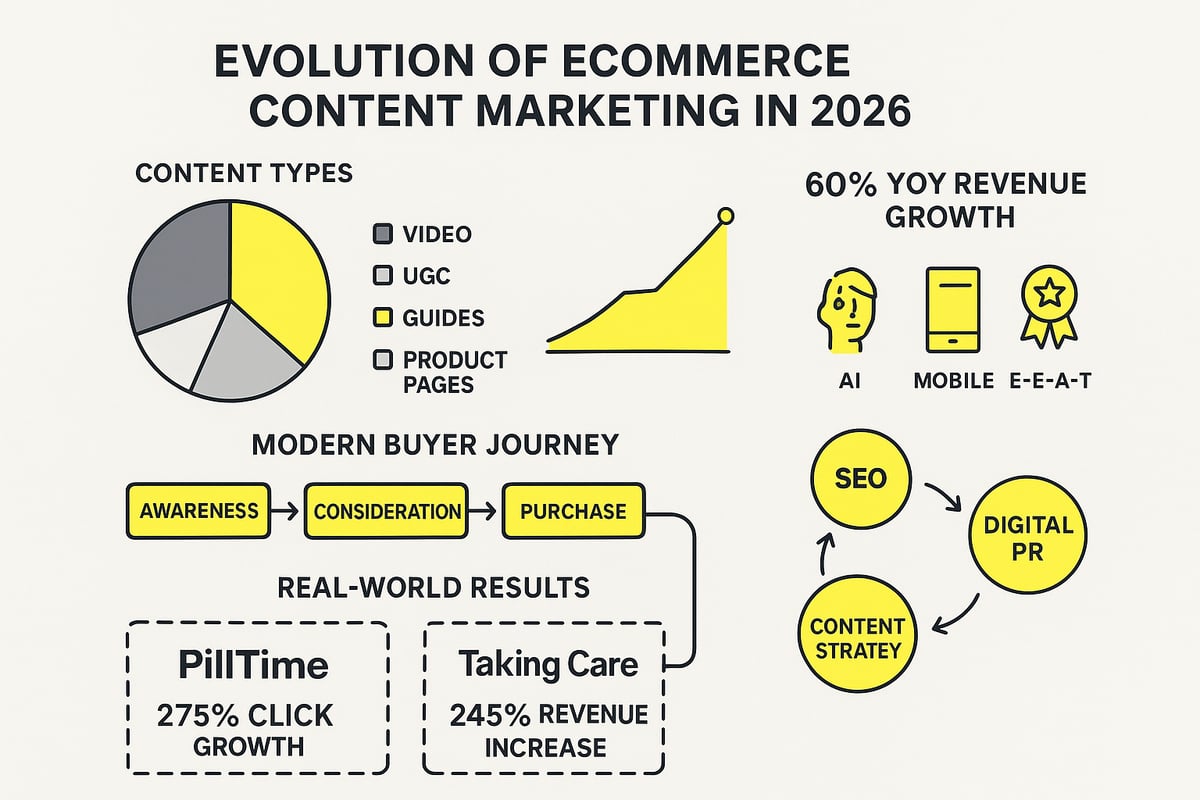
Key trends for 2025-2026 are redefining success. AI-driven content creation enables brands to scale personalization and relevance. Shoppable media, such as interactive videos and live shopping, merges content and commerce. User-generated content (UGC) and short-form video dominate social platforms, building credibility through real customer voices. According to the Taking Care case study, brands using strategic content saw a 60% year-over-year increase in online revenue.
Google’s E-E-A-T (Experience, Expertise, Authoritativeness, Trustworthiness) and evolving search algorithms now reward ecommerce sites that provide helpful, expert-driven content. This means ecommerce content marketing agency strategies must focus on quality, accuracy, and genuine value to rank and convert.
Consumers expect content tailored to their needs, interests, and pain points. Personalized buying guides, detailed product comparisons, and authentic brand stories are crucial for winning attention. Integrated content, SEO, and digital PR efforts are now essential for visibility and sustainable growth. To explore more about the future of content, see these Ecommerce content marketing trends for 2026.
Types of Content That Drive Results for Ecommerce Brands
An ecommerce content marketing agency leverages a variety of content types to drive results for different industries, from fashion and beauty to wellness and home.
- Product descriptions and category pages: Optimized for both search engines and conversion, these pages help buyers make confident decisions.
- Buying guides and how-to content: Step-by-step guides support decision-making and reduce purchase anxiety.
- Blog articles and brand storytelling: Thought leadership and behind-the-scenes stories build trust and authority.
- Social-first content: Short-form videos, influencer collaborations, and shoppable posts engage audiences on platforms like TikTok and Instagram.
- Interactive tools and user-generated reviews: Quizzes, calculators, and authentic customer reviews encourage interaction and social proof.
| Content Type | Purpose | Example Result |
|---|---|---|
| Product Pages | Drive conversions | +30,705 clicks (PillTime) |
| Buying Guides | Educate and support decisions | 4,149 new keywords (PillTime) |
| Social Video & UGC | Build engagement, trust | 209 backlinks (PillTime) |
| Blog & Brand Stories | Boost SEO, nurture loyalty | 60% YoY revenue (Taking Care) |
For instance, PillTime’s approach—focusing on keyword-optimized product content and leveraging user reviews—resulted in 30,705 additional clicks, 4,149 new ranking keywords, and 209 backlinks within months of launch. This demonstrates how the right ecommerce content marketing agency can transform visibility and sales.
In summary, a mix of educational, inspirational, and interactive content is key for ecommerce brands. By focusing on both the technical and creative elements, agencies help brands connect with their audience and achieve measurable growth.
Step-by-Step: How Ecommerce Content Marketing Agencies Deliver Success
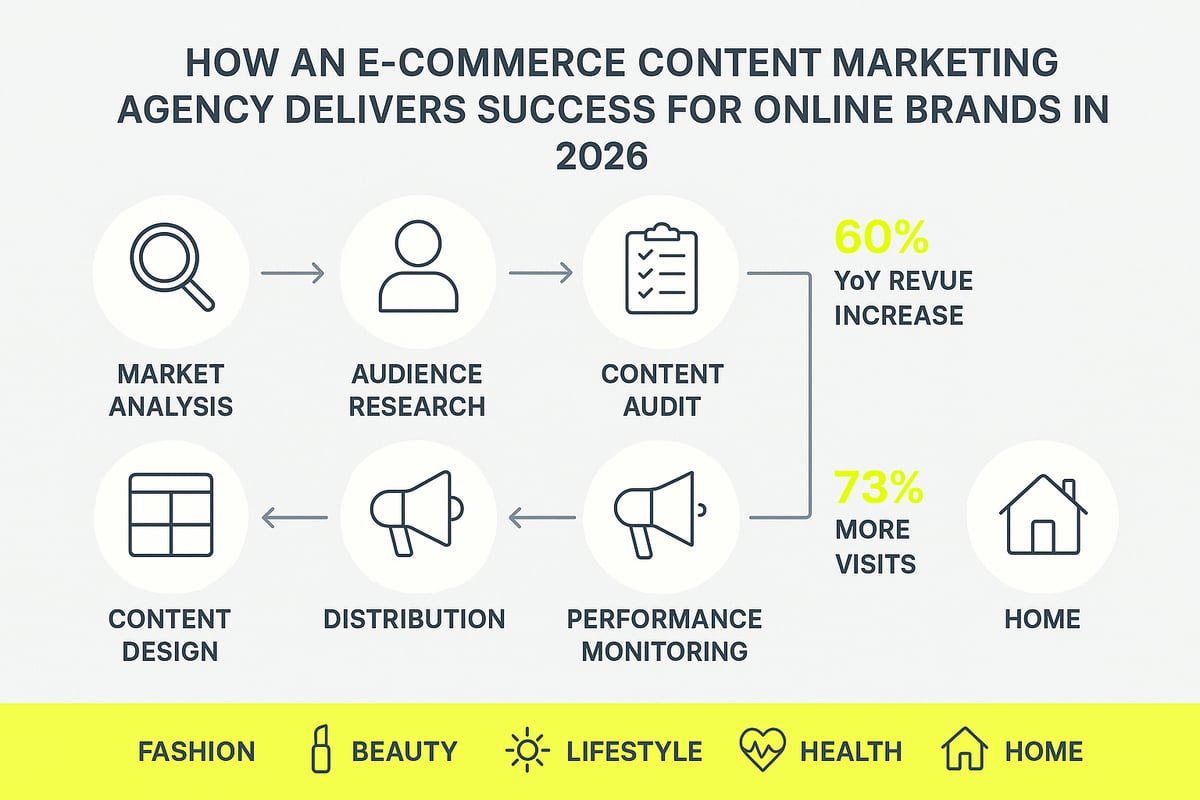
Partnering with an ecommerce content marketing agency sets the foundation for scalable growth in 2026. Agencies follow a proven, data-driven process designed to maximize visibility, authority, and sales for online brands. Let’s break down each step, using actionable instructions and real-world examples from leading ecommerce sectors.
1. In-Depth Market Analysis & Competitor Research
An ecommerce content marketing agency begins by mapping the competitive landscape for your vertical. They identify direct competitors and industry content leaders in fashion, beauty, home, wellness, or health.
Agencies use tools like SEMrush and Ahrefs to analyze competitors’ keyword rankings, content formats, and conversion tactics. For example, Taking Care, a leader in health and wellness, outperformed rivals by targeting high-value informational keywords and publishing expert-led guides.
Action steps:
- List top 5 competitors
- Review their highest-ranking content
- Identify gaps and opportunities
This groundwork ensures every content investment is based on real market data.
2. Audience Research, Persona Creation & User Journey Mapping
Next, the ecommerce content marketing agency collects demographic and behavioral insights from analytics, CRM platforms, and social listening tools. They build detailed buyer personas, focusing on motivations, pain points, and preferred channels.
For lifestyle and wellness brands, personas might highlight eco-conscious shoppers seeking value-driven content. Agencies then map the customer journey from discovery to retention, ensuring content aligns with every touchpoint.
How-to:
- Interview real customers
- Segment users by behavior and channel
- Visualize the journey from first click to repeat purchase
This step tailors campaigns for maximum relevance and impact.
3. Content Audit & Topical Authority Analysis
A thorough content audit is essential. The ecommerce content marketing agency reviews all product descriptions, category pages, and blog articles to assess performance, gaps, and outdated information.
They evaluate topical authority by measuring how well your content matches user search intent and industry trends. Brands that update old content see a 73% jump in website visits, as demonstrated by Taking Care’s strategy.
Checklist:
- Audit content for accuracy, SEO, and engagement
- Identify top-performing and underperforming assets
- Prioritize updates and new topic clusters
This step builds a strong foundation for future growth.
4. Keyword Research, Mapping & Intent Alignment
An ecommerce content marketing agency performs advanced keyword research, targeting transactional, informational, and navigational queries. They map keywords to specific product, category, and content pages, always aligning with search intent.
For instance, PillTime, a health brand, identified untapped keywords for a new market, leading to 4,149 new ranking terms after launch.
Steps:
- Use keyword tools to find high-value opportunities
- Group keywords by intent and funnel stage
- Assign keywords to relevant pages for optimization
This ensures every piece of content drives qualified traffic and conversions.
5. Content Design, Planning & Activation
Content creation is not just about writing. The ecommerce content marketing agency emphasizes design elements like scannability, accessibility, and conversion optimization.
Agencies organize collaborative planning sessions, bringing together creative and data teams to brainstorm, stress-test, and calendar campaigns. For example, fashion brands use content “crits” to refine lookbooks and shoppable posts before launch.
Best practices:
- Design for mobile-first experiences
- Use clear CTAs and structured layouts
- Plan content calendars aligned with product drops or sales events
This step maximizes engagement and conversion rates.
6. Content Distribution & Channel Strategy
Delivering content across the right channels is crucial. The ecommerce content marketing agency identifies where your audience spends time, whether it’s SEO, social, email, or digital PR.
They tailor formats for each platform: TikTok videos for beauty, Pinterest boards for home, Instagram for lifestyle. Amplification strategies include influencer partnerships and backlink campaigns.
Action plan:
- Select top-performing channels per sector
- Repurpose content for multi-channel reach
- Engage influencers and press for wider coverage
Brands that master distribution see exponential engagement and sales growth.
7. Performance Monitoring, Reporting & Iteration
Continuous improvement is at the heart of every ecommerce content marketing agency. They set up analytics and attribution for all content touchpoints, tracking KPIs like traffic, rankings, engagement, conversions, and revenue.
Monthly reports provide actionable insights, driving data-led optimization. For proof, explore Ecommerce marketing case studies showing 60% YoY revenue growth and thousands of new keywords for brands like PillTime and Taking Care.
To do:
- Monitor dashboards for real-time performance
- Review KPIs and assisted conversions monthly
- Refine strategy using results and market changes
This step locks in continuous growth and long-term ROI.
Choosing the Right Ecommerce Content Marketing Agency
Selecting the right ecommerce content marketing agency is a pivotal decision for any brand aiming to accelerate growth in 2026. The agency you choose can determine whether your content strategy drives sustainable revenue and market leadership or falls short in a fiercely competitive landscape.
To ensure your partnership delivers maximum value, follow these actionable steps:
Assess Industry Expertise
Look for an ecommerce content marketing agency with proven results in your sector. For instance, a beauty brand should prioritize agencies that have scaled similar brands, as shown by a 60% YoY revenue growth for wellness retailers. Ask for vertical-specific case studies and client references.Prioritize Integrated Services
The best agencies offer a unified approach: content, SEO, digital PR, and performance marketing. This integration amplifies results and streamlines communication. Review the agency’s ecommerce content marketing services to ensure they cover your full growth funnel.Balance Data and Creativity
Effective content combines brand storytelling with performance optimization. Agencies that blend creative production with analytics consistently outperform those focused on only one aspect. For example, a home and living brand achieved 7x ROAS by aligning creative campaigns with data insights.Demand Transparent Processes
Transparency in planning, reporting, and communication builds trust. Insist on clear timelines, regular progress updates, and monthly performance reports. This clarity is essential for adapting strategies in fast-moving ecommerce markets.Evaluate Technology and Tools
Agencies should use leading platforms for research, planning, and measurement. Tools like SEMrush, Ahrefs, and advanced analytics enable precise targeting and continuous optimization.Review Case Studies and Awards
Examine quantifiable results such as 50% conversion rate increases or 4,000+ new keywords ranked for fashion and lifestyle brands. National awards and industry recognition signal excellence and reliability.
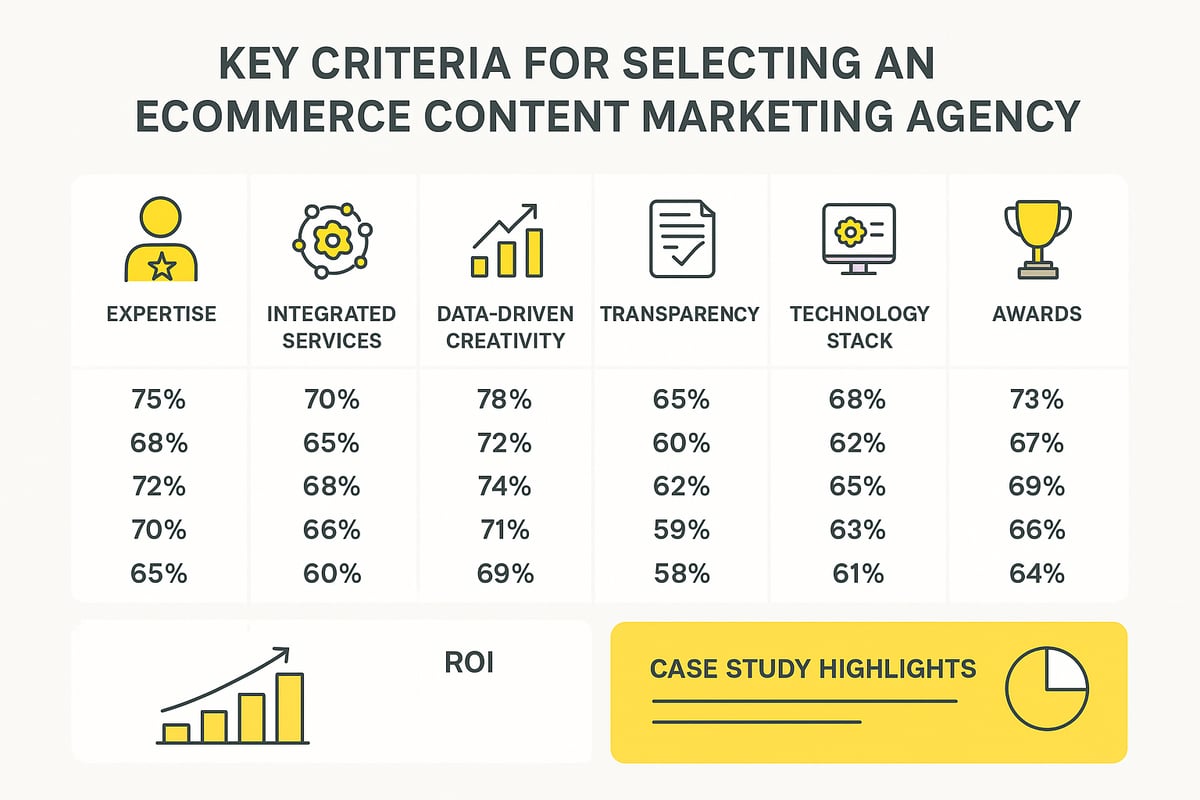
| Criteria | Why It Matters | Real-World Example |
|---|---|---|
| Industry Expertise | Sector-specific insights and strategies | Beauty: 60% revenue growth |
| Integrated Services | Unified campaigns for full-funnel impact | Lifestyle: 7x ROAS |
| Data & Creativity | Drives both brand and performance | Home: 4,000+ new keywords ranked |
| Transparency | Trust and agility in execution | Monthly reports, proactive updates |
| Technology Stack | Scalable, measurable results | SEMrush, Ahrefs, analytics |
| Case Studies & Awards | Proof of excellence and ROI | National accolades, client testimonials |
Choosing an ecommerce content marketing agency is not just about finding a service provider. It is about building a strategic partnership that propels your brand vision, adapts to new trends, and consistently delivers measurable results. Take the time to vet agencies against these criteria, and you will set the foundation for long-term ecommerce success.
Building a Future-Proof Ecommerce Content Strategy: 2026 and Beyond
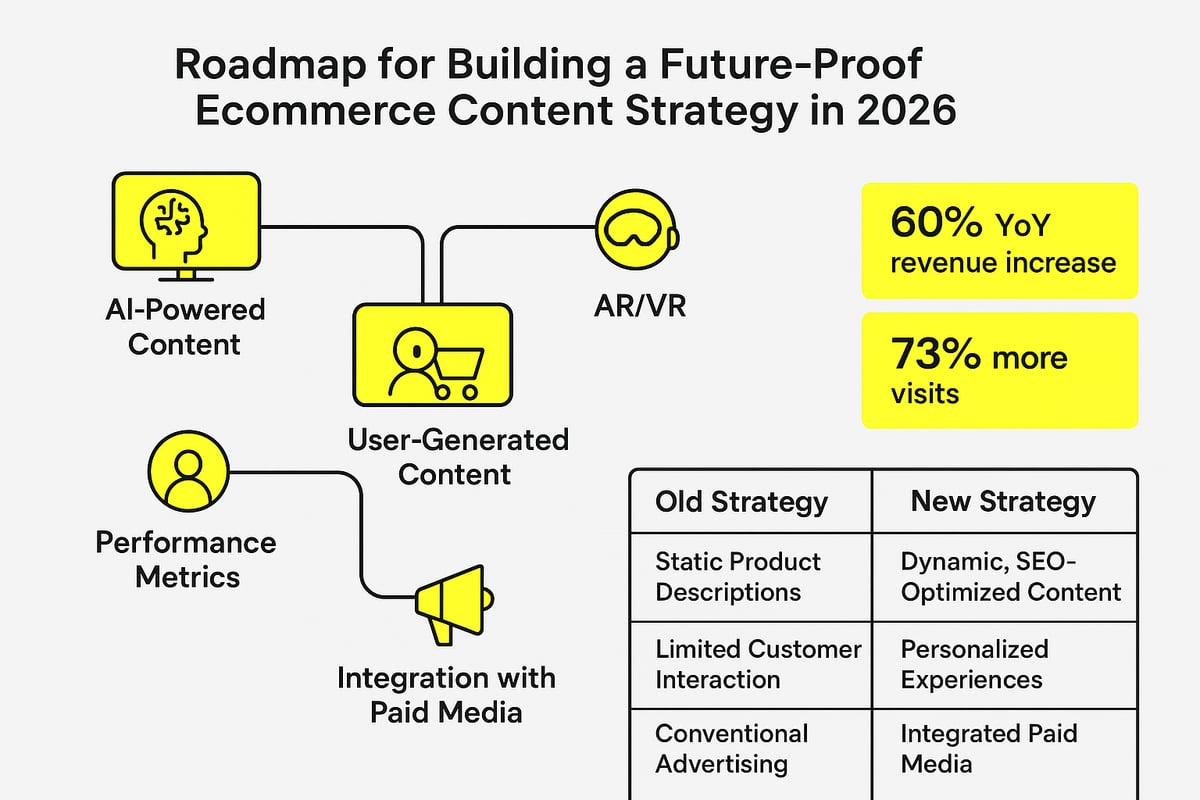
To thrive in 2026, ecommerce brands must design content strategies that adapt, evolve, and scale with changing consumer behavior and technology. A future-proof approach means blending innovation, data, and creativity, ensuring your ecommerce content marketing agency delivers measurable impact at every stage.
Embracing New Trends and Technologies
Staying ahead means your ecommerce content marketing agency must harness the latest innovations. AI-powered content creation enables brands to personalize messaging at scale, driving deeper engagement. For example, beauty brands now use AI to generate tailored product recommendations and dynamic landing pages, increasing conversion rates.
Shoppable video and livestream commerce are transforming product discovery, especially for fashion and lifestyle sectors. Incorporate AR/VR experiences to let shoppers virtually try before they buy, boosting confidence and trust.
User-generated content and social proof remain vital. Encourage customers to share reviews or photos, then feature them across channels. Prioritize data privacy and consent, aligning with evolving regulations.
For actionable guidance on leveraging AI, explore How to use AI in ecommerce. These trends, also highlighted in Top eCommerce trends shaping 2026, should anchor your roadmap.
Integrating Content with Performance Marketing
A high-impact ecommerce content marketing agency aligns content strategy with paid media for maximum ROI. Begin by mapping your content journey: awareness, consideration, and conversion touchpoints. Pair SEO-optimized articles with social ads and retargeting emails to build a unified funnel.
Use first-party data and segmentation to deliver hyper-targeted messages. For example, a home and living brand might launch a blog campaign about sustainable decor, then amplify it with Pinterest ads and follow up via email based on user interests.
Collaborate closely with your agency to synchronize content calendars, campaign launches, and reporting. This integration ensures every asset works together to move customers from discovery to purchase efficiently.
Measuring What Matters: KPIs for Modern Ecommerce Content
To prove value, your ecommerce content marketing agency should focus on revenue-driving metrics over vanity numbers. Set up dashboards to track assisted conversions, customer lifetime value, and retention rates, not just clicks or impressions.
Adopt a step-by-step measurement plan:
- Define clear business goals for each content campaign.
- Implement robust analytics and attribution for all touchpoints.
- Monitor performance in real time, adjusting strategy as needed.
For instance, health and wellness brands see higher ROI by tracking how educational guides contribute to repeat purchases. Transparent reporting and ongoing optimization are essential to long-term growth.
Real-World Success Stories
Brands that partner with a forward-thinking ecommerce content marketing agency are already seeing measurable results. Taking Care, in the health sector, achieved a 60% year-over-year revenue increase and 73% more website visits by integrating AI-powered content and digital PR.
PillTime, a wellness brand, generated 30,705 additional clicks and 4,149 new keyword rankings after launching a targeted content strategy. Fashion and lifestyle companies using shoppable video and UGC now dominate their categories, gaining both market share and customer trust.
These examples underscore that investing in future-ready content, backed by expert agency support, delivers sustainable growth and competitive advantage.
Frequently Asked Questions About Ecommerce Content Marketing Agencies
Staying ahead in ecommerce requires clarity on best practices and strategies. Below, we answer the most pressing questions brands ask when considering an ecommerce content marketing agency.
What is ecommerce content and how does it drive sales?
Ecommerce content includes product descriptions, category pages, buying guides, blogs, videos, and user-generated reviews. Each type supports the buyer journey by answering questions, building trust, and guiding decisions.
For example, fashion brands use detailed lookbooks and style guides to inspire purchases. Health and wellness brands share how-to articles and customer testimonials to boost confidence. A strong ecommerce content marketing agency crafts content that builds trust, educates, and nudges users toward checkout.
How do agencies create effective ecommerce content strategies?
A top ecommerce content marketing agency follows a structured, data-driven process:
- Research your market, competitors, and audience.
- Audit existing content and identify gaps.
- Perform keyword research for transactional and informational queries.
- Map content to each stage of the customer journey.
- Plan, create, and distribute content across SEO, social, and email.
- Monitor performance and iterate based on analytics.
For instance, PillTime grew organic clicks by over 30,000 using targeted keyword strategies and persona-driven content.
Do you need an agency or can you do it in-house?
Choosing between an ecommerce content marketing agency and an in-house team depends on your resources and goals.
In-house:
- Full control and brand knowledge
- Requires hiring and training specialists
Agency:
- Deep expertise, proven frameworks, and access to advanced tools
- Scalable and faster to launch campaigns
Many fast-growing lifestyle and home brands partner with agencies to accelerate growth and stay ahead of trends.
How do you measure ROI from content marketing?
Measuring ROI means tracking revenue, conversions, engagement, and assisted sales. Set up analytics to monitor key metrics like click-through rates, keyword rankings, and conversion rates.
For actionable tips, review CRO strategies for ecommerce brands, which detail how to optimize content for more sales. Taking Care reported a 60% YoY revenue increase after updating and expanding their content.
What are the top trends shaping ecommerce content marketing in 2026?
Key trends for 2026 include:
- AI-powered content creation and personalization
- Shoppable videos and livestream commerce
- User-generated content and influencer collaborations
- Data privacy and consent-driven marketing
Recent ecommerce statistics and insights for 2025 show surging mobile commerce and the rise of video as dominant formats. Brands that embrace these trends gain an edge in conversion and loyalty.
How does content marketing integrate with SEO and paid media?
Successful agencies align content with SEO and paid campaigns for maximum reach. For example, a beauty brand may launch a keyword-optimized blog series, promote it with social ads, and retarget visitors via email. This synergy amplifies visibility and drives more qualified traffic to product pages.
What should you look for in an agency partner?
Look for an ecommerce content marketing agency with:
- Sector expertise (fashion, beauty, wellness, home)
- Proven results and case studies
- Integrated services (content, SEO, digital PR)
- Transparent communication and reporting
- Recognition or awards
Brands like Taking Care and PillTime achieved substantial growth by choosing agencies with a track record of driving measurable results.
As you look to position your ecommerce brand for long-term growth in 2026, the right agency partnership can make all the difference. We’ve explored how a balance of creativity and data-driven strategy drives real results—from higher conversion rates to lasting brand trust. If you’re ready to take the next step and want a tailored approach that combines innovative content, full-funnel marketing, and measurable impact, let’s connect. We’re here to help you turn strategy into success.
Contact us
and discover how Good Karma Agency can accelerate your brand’s journey.


