
Imagine seeing your e-commerce sales double in a single night. In 2026, this is not just wishful thinking—it's a reality for brands mastering the latest e commerce ads strategies.
This guide unpacks the new rules, breakthrough platforms, and proven tactics shaping e commerce ads in 2026. We will dive into emerging trends, platform-specific playbooks, and the creative techniques driving real growth for fashion, beauty, lifestyle, health, and home brands.
You will discover how top brands like Daily Paper and Sephora are using data, personalization, and bold creative to achieve up to 7x ROAS. Ready to turn insights into action? Follow our step-by-step strategies to make your e-commerce brand thrive in the evolving ad landscape.
The Evolution of E-Commerce Ads: 2020–2026
The world of e commerce ads has transformed dramatically between 2020 and 2026. Brands have adapted to new technologies, shifting consumer expectations, and platform innovations. Understanding this evolution is key to building campaigns that drive results in today’s competitive landscape.
Key Milestones in E-Commerce Advertising
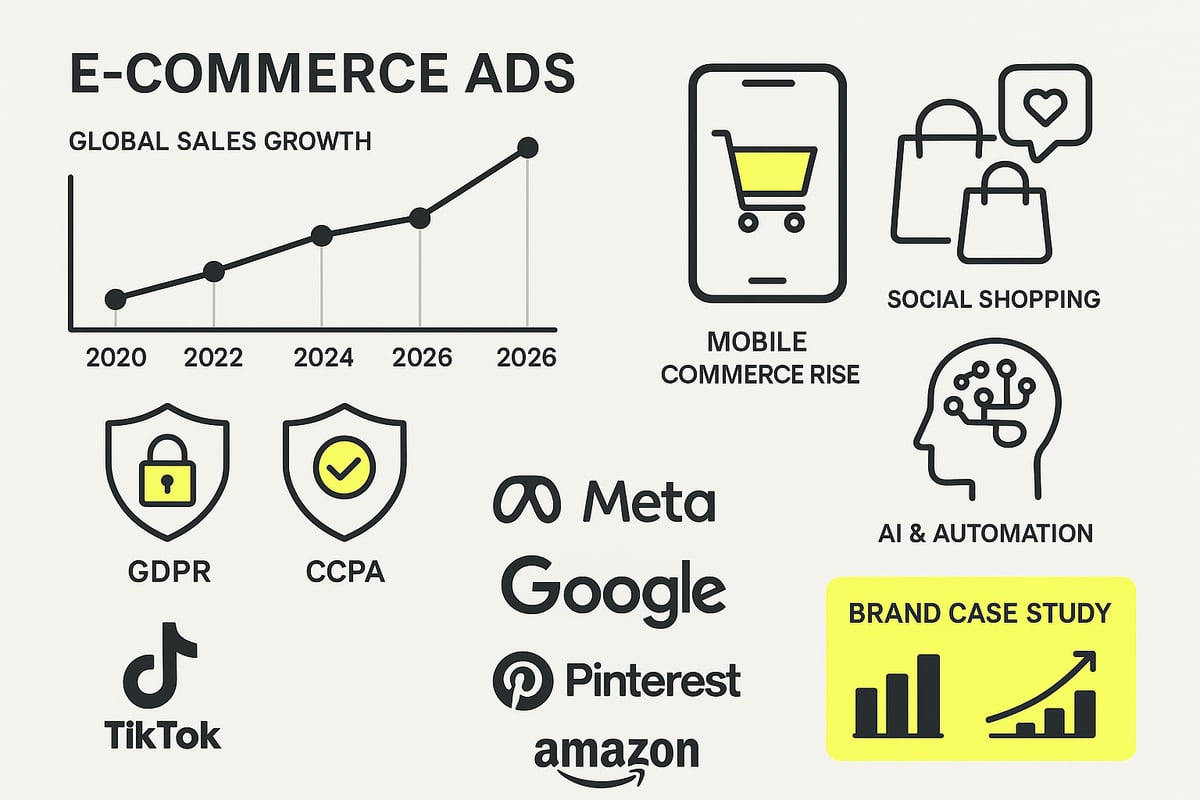
From 2020 to 2026, e commerce ads have seen several pivotal milestones:
- Global e-commerce sales surged from $4.2 trillion in 2020 to a projected $7.5 trillion in 2026.
- Mobile commerce and social shopping became the norm, with most traffic coming from smartphones.
- Ad formats expanded rapidly: brands embraced video, shoppable posts, and immersive AR/VR experiences.
- Privacy regulations like GDPR, CCPA, and iOS 14+ reshaped data usage and targeting.
- AI-driven personalization and automation emerged as game changers, allowing brands to deliver smarter campaigns. For a deeper dive, see AI in e-commerce advertising.
Staying ahead means adopting these milestones as part of your ongoing strategy.
Shifts in Consumer Behavior
Consumer expectations for e commerce ads have shifted quickly:
- 68% of shoppers now find products through social media (Statista, 2025).
- Seamless, one-click checkout is expected at every step.
- Authenticity rules: user-generated content (UGC) outperforms polished brand ads.
- Personalization is no longer optional; shoppers want ads tailored to their interests.
To win, brands must create genuine, frictionless journeys that put the customer at the center.
Major Platform Changes and Innovations
The platforms powering e commerce ads have evolved rapidly:
- TikTok leads social commerce, making short-form video shoppable and viral.
- Meta uses AI-driven product feeds and integrates Instagram Shop with live shopping.
- Google’s Performance Max campaigns automate catalog promotion across Search, YouTube, and Display.
- Pinterest’s visual search and shoppable pins unlock new discovery paths.
- Amazon and Walmart both doubled down on programmatic and off-site ad offerings.
Each platform now demands a unique, optimized approach for best results.
Lessons from Leading Brands
Top brands have rewritten the playbook for e commerce ads by testing new tactics:
- Daily Paper drove 4x ROAS with TikTok ad campaigns targeting Gen Z.
- Sephora used AR try-ons in Instagram ads, boosting engagement for beauty shoppers.
- IKEA’s shoppable video ads on Pinterest increased home product sales.
- AG1 leveraged influencer-driven UGC ads to build trust and conversions.
- Colourful Rebel used multi-channel retargeting to re-engage and convert lifestyle audiences.
Emulate these strategies by combining innovation, creativity, and data-driven insights in every campaign.
Core E-Commerce Ad Platforms & Their 2026 Playbooks
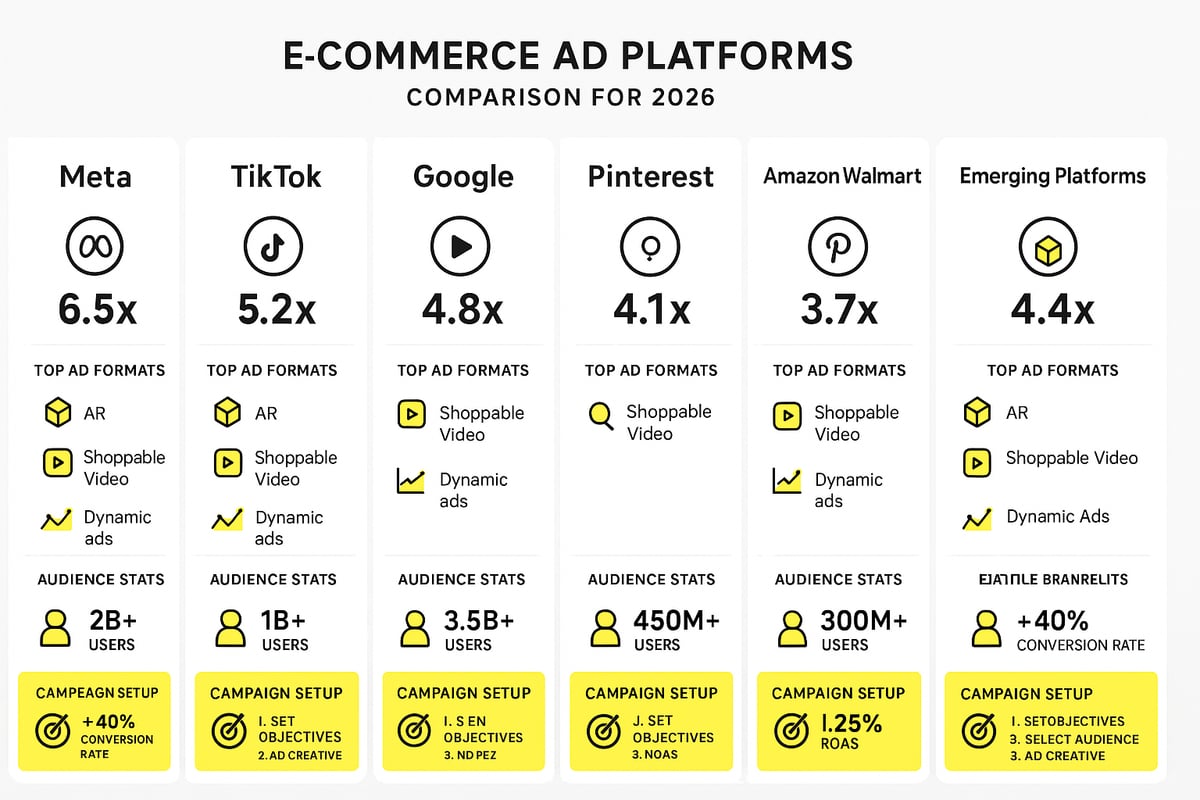
Success with e commerce ads in 2026 hinges on mastering the playbooks of leading platforms. Each channel offers unique tools, targeting, and creative possibilities. Let’s break down the strategies, innovations, and real-world brand wins that define each platform’s roadmap this year.
Meta (Facebook & Instagram)
Meta’s 2026 playbook for e commerce ads is built on AI and seamless shopping. Start by enabling Dynamic Product Ads, which use AI to tailor product recommendations 1:1. Integrate your Shopify or e-commerce catalog with Instagram Shop for instant, in-app purchases.
Host live shopping events to boost engagement and drive urgency. Experiment with new placements in Stories, Reels, and Messenger for broader reach. Brands like Anna+Nina have achieved a 6.5x ROAS by running carousel ads with fresh creative every week.
Action Steps:
- Sync your product feed with Meta Commerce Manager.
- Launch Dynamic Product Ads using AI-powered targeting.
- Host monthly live shopping events.
- Refresh creative weekly to avoid ad fatigue.
Meta remains essential for scalable, high-performing e commerce ads.
TikTok & Short-Form Video
TikTok is now the top discovery engine for Gen Z, making it vital for e commerce ads. Use Spark Ads to amplify organic content, then launch shoppable in-feed videos. Tap into TikTok Shop for direct checkout and partner with creators for authentic product demos.
Trends show 70% of Gen Z prefer product discovery through TikTok. Filling Pieces, a fashion brand, leveraged viral UGC to skyrocket engagement and sales.
Step-by-Step:
- Identify trending sounds and formats.
- Collaborate with micro-influencers for UGC.
- Test shoppable video ads linked to TikTok Shop.
- Optimize based on engagement and conversion data.
TikTok rewards brands who move fast and embrace native, creative storytelling in e commerce ads.
Google Ads & Performance Max
Performance Max campaigns are the backbone of Google’s approach to e commerce ads. Automate campaign setup by connecting your product catalog, then let Google’s AI optimize placements across Search, Shopping, YouTube, and Display.
Leverage smart bidding and audience signals to maximize conversions. One fashion brand reported a 40% lift in conversion rate using Performance Max. For a deeper dive into proven strategies, explore this guide on performance marketing for e-commerce.
How to Implement:
- Upload your full product feed to Google Merchant Center.
- Launch a Performance Max campaign with clear goals.
- Enable audience signals for retargeting and new customer acquisition.
- Monitor ROAS and adjust budget weekly.
Google’s automation and reach make it a must for scaling e commerce ads across touchpoints.
Pinterest & Visual Discovery
Pinterest’s visual-first platform excels at intent-driven e commerce ads. Set up Shoppable Pins and connect your catalog via the Pinterest Shopping API. Use visual search to reach home, beauty, and lifestyle shoppers at the inspiration stage.
Collaborate with creators for authentic content and launch collaborative boards to boost engagement. The Mercer Brand saw strong results running home décor campaigns with shoppable video and interactive Pins.
Actionable Tips:
- Optimize product images for visual search.
- Launch creator partnerships for seasonal trends.
- Use collaborative boards to build community.
Pinterest is ideal for brands aiming to spark discovery and drive high-intent traffic with e commerce ads.
Amazon, Walmart, and Retail Media Networks
Retail media ecosystems like Amazon and Walmart are powerhouses for e commerce ads in 2026. Launch Sponsored Products and Display campaigns, then build branded stores to guide shoppers through curated journeys.
Use purchase intent signals for targeting and expand into off-site programmatic ads to reach shoppers wherever they browse. A health supplement brand increased sales 3x using Amazon DSP’s data-driven targeting.
Step-by-Step Plan:
- Set up Sponsored Products for bestsellers.
- Create a branded store with category pages.
- Layer in programmatic ads for broader visibility.
- Analyze purchase data to refine targeting.
Retail media networks offer unmatched scale and purchase-ready audiences for e commerce ads.
Emerging Platforms: Snapchat, YouTube Shorts, and Beyond
Emerging channels are shaping the future of e commerce ads. Snapchat’s AR try-on ads allow beauty brands to offer interactive product experiences. YouTube Shorts supports shoppable video, letting users buy with a tap. Niche platforms like Lyst cater to luxury and fashion audiences.
A beauty brand’s AR filter campaign on Snapchat led to a 25% lift in trial rates. For best results, test new formats and measure impact early.
Quick Wins:
- Launch AR try-on ads for new product drops.
- Integrate shoppable links into YouTube Shorts.
- Explore niche marketplaces for targeted reach.
Staying ahead with emerging platforms keeps your e commerce ads strategy innovative and future-proof.
Winning Creative Strategies for E-Commerce Ads in 2026
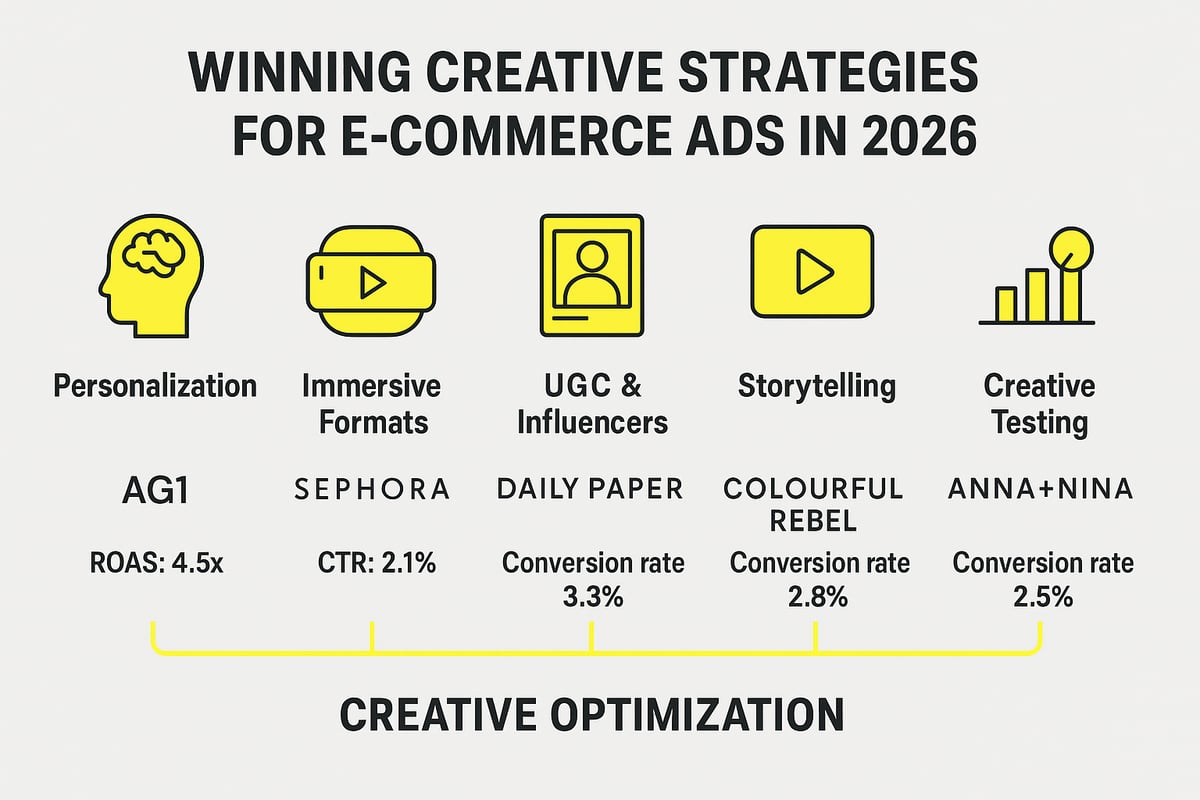
Driving results with e commerce ads in 2026 depends on creative strategies that capture attention, inspire trust, and move customers to action. Brands that master personalization, interaction, authenticity, storytelling, and rapid iteration will consistently outperform the competition.
Personalization & Dynamic Content
In 2026, e commerce ads win by delivering hyper-personalized experiences at scale. Brands use real-time browsing and purchase data to serve product recommendations tailored to each user. For example, AG1's supplement ads dynamically bundle products based on individual health goals and past orders.
To implement this:
- Integrate AI tools with your product catalog and ad platforms.
- Segment audiences using first-party data.
- Create dynamic templates for pricing, offers, and images.
- Test different content variations to identify top performers.
A/B testing and AI-generated creative ensure every touchpoint feels relevant. This approach increases engagement and conversion rates, making personalization non-negotiable for e commerce ads.
Interactive & Immersive Ad Formats
E commerce ads in 2026 engage shoppers through AR try-ons, 3D demos, and shoppable livestreams. Sephora's AR lipstick try-on ads let users virtually sample shades, driving a 32% lift in add-to-carts. Shoppable livestreams, where viewers buy directly during broadcasts, are now mainstream.
To get started:
- Use AR/VR tools on platforms like Snapchat and Instagram.
- Host live shopping events with real-time checkout.
- Add polls, quizzes, and gamified elements to ads.
According to Interactive and shoppable ads in 2026, these formats are essential for capturing today’s attention-spans and driving direct sales through e commerce ads.
User-Generated Content (UGC) & Influencer Partnerships
Authenticity powers the best e commerce ads. Brands like Colourful Rebel run UGC contests, encouraging customers to share real photos for a chance to be featured. This approach fuels viral reach and trust, with UGC-based ads often outperforming studio-shot content.
To maximize UGC:
- Ask for customer reviews and social shares post-purchase.
- Partner with micro-influencers for targeted campaigns.
- Curate top UGC in your ads across TikTok and Instagram.
Filling Pieces’s viral TikTok campaigns show that relatable, peer-driven content can turn browsers into buyers. UGC makes e commerce ads more credible and relatable.
Storytelling & Brand Building
Short-form video storytelling is a cornerstone of effective e commerce ads. Daily Paper’s “journey” series on Instagram Reels showcases behind-the-scenes moments and founder stories, deepening emotional connections with their audience.
To apply this:
- Craft a brand narrative that resonates with your target audience.
- Use video to highlight product origins, team culture, or customer journeys.
- Maintain a consistent voice and style across all channels.
Stories build brand equity, differentiate your products, and drive loyalty, making storytelling indispensable for e commerce ads.
Creative Testing & Iteration
Continuous testing is critical for e commerce ads to avoid creative fatigue and maximize ROI. Anna+Nina conducts weekly creative sprints, running A/B tests on headlines, visuals, and calls to action. This agile process led to a 30% increase in click-through rates.
Implement this by:
- Scheduling regular creative refreshes.
- Using AI tools for multivariate testing.
- Analyzing performance data and quickly scaling winners.
A structured testing framework ensures your e commerce ads stay fresh, relevant, and high-performing across every platform.
Advanced Targeting, Automation & AI in 2026 E-Commerce Ads
The 2026 landscape for e commerce ads is defined by precision, automation, and privacy-first strategies. Brands in fashion, beauty, lifestyle, health, and home sectors are leveraging advanced tools to reach the right customers, optimize spend, and build loyalty in a privacy-conscious world.
Data-Driven Audience Segmentation
Modern e commerce ads rely on first-party data and predictive modeling to identify high-value audiences. With third-party cookies fading, brands use purchase history, browsing behavior, and engagement signals to create precise segments. Methods include lookalike audiences, predictive scoring, and contextual targeting for privacy compliance.
| Segmentation Type | Data Source | Benefit |
|---|---|---|
| First-party | Site/app activity | Greater accuracy |
| Predictive | AI modeling | Future intent targeting |
| Contextual | On-page signals | Privacy-safe targeting |
To get started:
- Map your existing data sources.
- Use AI tools to build predictive segments.
- Apply contextual targeting for privacy compliance.
For actionable tips, see these advanced audience targeting tips. A home decor brand recently used purchase and browsing data to retarget lapsed buyers, achieving a 30% lift in repeat purchases through e commerce ads.
AI-Powered Campaign Optimization
AI now automates budget allocation, bid strategies, and creative delivery in e commerce ads. Platforms like Meta and Google use machine learning to predict which products, audiences, and creatives will drive the highest ROAS. Brands in the beauty sector adopt AI-powered tools to test hundreds of creative variations, optimizing for metrics like CTR and conversion rate.
Step-by-step to leverage AI:
- Set clear campaign goals and KPIs.
- Enable automated bidding and budget optimization.
- Use AI-based creative selection tools for ongoing improvement.
A Shopify store in wellness boosted ROAS by 60% after automating campaign optimization for their e commerce ads, letting AI reallocate spend to top-converting products in real time.
Conversational & Chatbot Ads
Conversational commerce is reshaping e commerce ads. Integrating Messenger and WhatsApp chatbots within ad flows allows brands to provide instant product recommendations, answer questions, and even process orders. This creates a seamless, personalized experience that increases conversions and customer satisfaction.
How to implement:
- Connect chat-based ad formats (Messenger, WhatsApp) to your product catalog.
- Train AI chatbots to handle FAQs and recommend products.
- Monitor performance and refine scripts for better engagement.
A health brand used WhatsApp-integrated e commerce ads to deliver personalized supplement bundles, resulting in a 35% higher upsell rate compared to static ads.
Cross-Channel & Omnichannel Retargeting
Winning in 2026 means unifying customer data across platforms for seamless retargeting. E commerce ads now follow users from web to app to physical store, adapting messaging based on funnel stage and location. Sequential messaging and geo-targeted offers drive higher engagement and in-store traffic.
Action steps:
- Build unified customer profiles from all touchpoints.
- Set up sequential ad flows tailored to each funnel stage.
- Use geo-targeting for local promotions.
A lifestyle brand orchestrated cross-channel e commerce ads on Meta, Google, and email, raising their conversion rate by 25% through tailored retargeting sequences.
Privacy, Consent, and Compliance
Stricter global privacy laws have reshaped e commerce ads, requiring brands to prioritize user consent and transparency. GDPR, CCPA, and similar regulations mandate clear opt-ins and privacy-first measurement solutions. Brands now implement transparent consent flows and use aggregated data for performance tracking.
Best practices:
- Audit your consent management processes.
- Use privacy-compliant measurement tools.
- Communicate clear value in exchange for data.
A fashion retailer increased lead opt-ins by 20% after redesigning their e commerce ads with transparent, value-driven consent prompts, ensuring compliance and maintaining customer trust.
Measurement, Attribution & Scaling E-Commerce Ads in 2026
In 2026, precise measurement and smart scaling define e commerce ads success. Brands must track performance across the funnel, use advanced attribution, and apply continual optimization to maximize return on ad spend. Let’s break down the essential steps and tools for measurement, attribution, and campaign growth.
Key Metrics for E-Commerce Ad Success
To scale e commerce ads, brands must measure the right metrics. Focus on:
- Customer Acquisition Cost (CAC)
- Return on Ad Spend (ROAS)
- Customer Lifetime Value (CLV)
- Click-Through Rate (CTR)
- Conversion Rate (CVR)
- Average Order Value (AOV)
- Retention Rate
For example, Daily Paper achieved a 50% lift in conversion rate after optimizing their funnel. Fashion brands often target a 7x ROAS on Meta, while beauty brands use CLV to refine budget allocation. Track these metrics weekly to identify top-performing campaigns and optimize spend.
Multi-Touch Attribution Models
Attribution is critical for understanding which e commerce ads drive results. Move beyond last-click models to data-driven attribution, which assigns value across the customer journey. Integrate platforms for unified reporting, and use AI to analyze touchpoints.
For instance, a beauty brand shifted budget after multi-touch insights showed Instagram ads influenced 60% of purchases, even if final clicks came from Google. Reviewing case studies of successful ad campaigns can reveal how leading brands leverage attribution to improve ROI and inform strategy.
Incrementality Testing & Experimentation
Incrementality testing shows the true impact of e commerce ads by comparing exposed and control groups. Use holdout tests, geo-experiments, and split tests to measure lift and avoid cannibalization.
A home brand ran split tests on creative and targeting, resulting in 25% higher sales after identifying the most effective ad variant. Continuous experimentation is key: test one variable at a time, analyze results, and scale what works. Document learnings to refine future campaigns.
Scaling Winning Campaigns
Once you identify high-performing e commerce ads, scale them with a structured approach:
- Allocate more budget to winning creatives in real time.
- Expand to new markets and localize messaging.
- Repurpose top-performing assets across platforms.
- Automate budget shifts based on performance data.
AG1, for example, scaled TikTok ads across EU markets by localizing video content and doubling budget on best-performing segments. Fashion and lifestyle brands often see exponential growth by replicating successful campaigns internationally.
Common Pitfalls & How to Avoid Them
Avoid these common mistakes when managing e commerce ads:
| Pitfall | Impact | Solution |
|---|---|---|
| Ad fatigue | Lower CTR, higher CAC | Refresh creative weekly |
| Over-targeting | Shrinking reach | Broaden audience segments |
| Misattribution | Wasted spend | Use multi-touch attribution |
A fashion brand overcame over-segmentation by merging similar audiences and saw a 20% spike in reach. Regular audits, creative refresh cycles, and robust attribution tools will keep e commerce ads effective and scalable.
Step-by-Step Action Plan: Launching High-Performing E-Commerce Ads in 2026
Launching high-performing e commerce ads in 2026 requires a structured, data-driven approach. Follow these four essential steps to ensure your campaigns are set up for measurable success and long-term growth.
1. Define Objectives & KPIs
Begin by setting clear, measurable objectives for your e commerce ads. Use SMART goals to drive focus, such as targeting a 5x ROAS for a new product line or acquiring 2,000 new customers monthly. Align KPIs with your business stage—whether launching or scaling.
Leverage recent digital advertising statistics for 2026 to benchmark performance. For example, leading fashion brands are aiming for a 7x ROAS and a 50% lift in conversion rates. Data-driven goals ensure every campaign is accountable and primed for growth.
2. Choose the Right Platforms & Budget
Select platforms where your audience actively engages with e commerce ads. Evaluate Meta for dynamic product ads, TikTok for short-form discovery, Google for high-intent search, and Pinterest for visual shopping. Diversify your spend based on sector trends; for instance, a fashion brand might allocate 40% to TikTok, 30% to Meta, 20% to Google, and 10% to Pinterest.
Balance your budget between brand building and performance. Analyze where your competitors excel, and adjust spend to maximize reach and ROI. Test emerging platforms if your audience skews toward Gen Z or niche markets.
3. Build Creative Assets & Landing Pages
Develop visually rich, platform-specific creatives for your e commerce ads. Invest in UGC, AR try-ons, and dynamic content that reflects your brand voice. For example, a home brand could launch an AR-powered product demo page, while a beauty brand uses influencer video reviews.
Embrace AI-powered personalization in e-commerce to dynamically adjust offers, product recommendations, and creative variations in real time. Optimize every landing page for speed, mobile experience, and conversion.
4. Launch, Test, and Optimize
Deploy your e commerce ads with segmented audiences for precise targeting. Structure campaigns for easy A/B testing of headlines, images, and calls to action. Monitor key metrics daily—CAC, ROAS, CVR—and iterate weekly to boost performance.
For instance, a beauty brand improved CAC by 20% through rapid creative testing, while a lifestyle retailer increased retention with sequential retargeting. Continuous experimentation and data-driven adjustments keep your ads competitive and effective.
Good Karma Agency: Your E-Commerce Growth Partner
Ready to level up your e commerce ads in 2026? Good Karma Agency partners with ambitious brands like Stanley, Daily Paper, Colourful Rebel, and AG1 to drive measurable growth across every major platform. Our team blends creative production, Shopify development, and data-driven campaign management to deliver outcomes like 7x ROAS and 50 percent higher conversion rates.

We offer step by step support, from concepting scroll stopping ad creatives to optimizing omnichannel campaigns and landing pages for maximum impact. Brands in fashion, beauty, and lifestyle rely on our expertise to stay ahead, tapping into innovations like live commerce and creator economy trends highlighted in Live commerce and creator economy trends. Discover how our integrated approach to e commerce ads can unlock your next phase of scalable growth.
As you look ahead to mastering e commerce ads in 2026, it’s clear that success isn’t just about following trends—it’s about combining creative vision with smart, data driven strategy. We’ve explored how brands are leveraging next gen platforms, AI powered personalization, and dynamic storytelling to stand out and drive growth. If you’re ready to elevate your brand with a partner who truly understands the balance of brand and performance, let’s talk about how we can help you achieve measurable results with confidence.
Contact us
and unlock your next level of e commerce growth.


