
Creative advertising represents the intersection where art meets science in the ecommerce landscape. For direct-to-consumer brands in fashion, beauty, lifestyle, and wellness sectors, it's no longer enough to simply run ads that look good or ads that convert well. The most successful campaigns in 2026 achieve both simultaneously. According to Nielsen research, campaigns that balance creative excellence with performance optimization deliver 50% higher ROI than those focused solely on one dimension. This comprehensive guide explores how ecommerce brands can implement creative advertising strategies that drive measurable growth while building lasting brand equity.
Understanding Creative Advertising in the Ecommerce Context
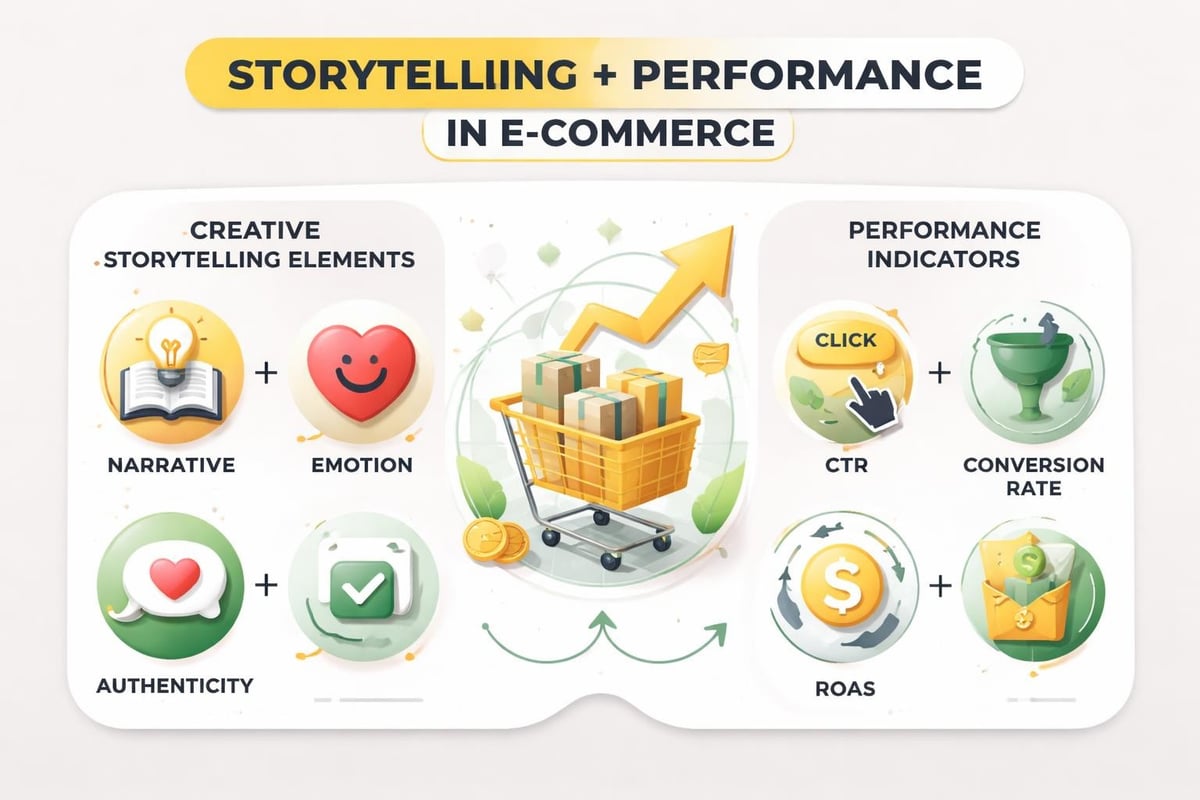
Creative advertising goes beyond aesthetic appeal. It combines compelling storytelling, emotional resonance, and strategic messaging with data-driven optimization to achieve specific business outcomes. For ecommerce brands, this means crafting campaigns that not only capture attention but also drive clicks, add-to-carts, and purchases.
The landscape has evolved dramatically. What worked in traditional advertising doesn't always translate to digital platforms where consumers scroll past hundreds of ads daily. Research from Amazon Ads demonstrates that creative quality accounts for 70% of campaign effectiveness, while targeting and placement contribute the remaining 30%.
The Performance-Brand Balance
Most agencies fall into two categories: performance-focused teams that optimize ruthlessly for conversions but create forgettable ads, or brand-focused teams that produce beautiful campaigns with unclear ROI. The sweet spot exists at their intersection.
Key metrics successful creative advertising impacts:
- Click-through rates (CTR) improving by 2-3x with creative optimization
- Cost per acquisition (CPA) reduction of 30-40% through better messaging
- Customer lifetime value (LTV) increase of 60% when brand storytelling resonates
- Ad fatigue reduction, extending campaign lifespan by 50-100%
Glossier, a beauty brand that grew to $200 million in revenue, attributes much of its success to creative advertising that feels authentic rather than promotional. Their user-generated content campaigns achieve 4x higher engagement rates than traditional product shots while maintaining strong conversion rates.
Building a Creative Advertising Framework for Ecommerce
Implementing effective creative advertising requires a structured approach that balances experimentation with measurement. Here's a step-by-step framework specifically designed for Shopify-based ecommerce brands.
Step 1: Establish Your Creative Foundation
Before launching campaigns, document your brand's creative parameters. This ensures consistency while allowing flexibility for testing.
Create a creative brief template including:
- Brand voice guidelines - tone, language, phrases to use and avoid
- Visual identity standards - color palettes, typography, imagery style
- Core messaging pillars - 3-5 key value propositions
- Audience personas - detailed profiles including pain points and aspirations
- Differentiation points - what makes your brand unique versus competitors
Allbirds, the sustainable footwear brand, built a creative framework around environmental messaging that resonates emotionally while driving conversions. Their campaigns consistently communicate sustainability without sacrificing performance, achieving a 45% year-over-year growth rate.
Step 2: Develop Platform-Specific Creative Strategies
Each advertising platform requires tailored creative approaches. What performs on Meta differs significantly from TikTok or Pinterest.
| Platform | Creative Best Practices | Optimal Format | Average CTR |
|---|---|---|---|
| Meta (Facebook/Instagram) | First 3 seconds critical, mobile-first vertical | Stories, Reels, Carousel | 0.9-1.2% |
| TikTok | Native feel, trending sounds, authentic creators | Full-screen vertical video | 1.5-2.5% |
| Google Shopping | High-quality product images, clear pricing | Image + text overlay | 0.7-1.0% |
| Aspirational lifestyle imagery, bright colors | Vertical pins (2:3 ratio) | 0.2-0.4% |
For fashion and lifestyle brands, Pinterest delivers exceptional results when creative advertising showcases products in aspirational contexts. Reformation, a sustainable fashion brand, generates 25% of its ecommerce traffic from Pinterest through lifestyle-focused creative that feels inspirational rather than transactional.
Step 3: Implement Creative Testing Protocols
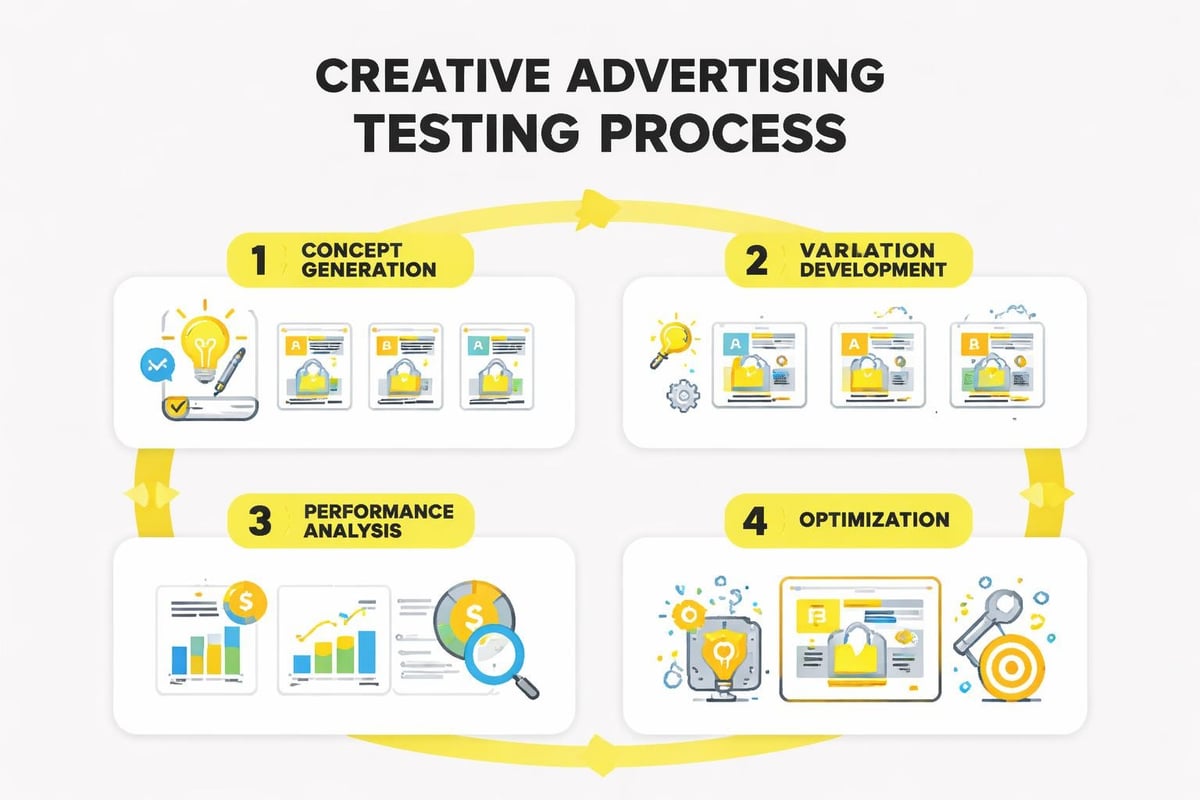
Systematic testing separates successful campaigns from mediocre ones. Establish a structured approach to creative experimentation that generates actionable insights.
Follow this testing framework:
- Generate 5-7 creative variants for each campaign
- Test one variable at a time - hook, visual, call-to-action, or format
- Run tests for minimum 3-4 days to gather statistical significance
- Allocate 20% of budget to testing, 80% to proven winners
- Document results in a creative library for future reference
- Refresh winning ads every 14-21 days to combat creative fatigue
Beauty brand Glossier tests over 100 creative variations monthly, maintaining a creative refresh cycle that keeps campaigns performing at peak efficiency. Their systematic approach to creative advertising has contributed to customer acquisition costs 50% lower than industry averages.
Advanced Creative Advertising Techniques
Once foundational systems are established, advanced techniques unlock additional performance gains. These strategies leverage emerging technologies and psychological principles to maximize creative impact.
Dynamic Creative Optimization
Modern advertising platforms offer dynamic creative optimization (DCO) that automatically assembles ad components based on user signals. This technology enables personalization at scale while maintaining brand consistency.
Implementation steps:
- Create modular creative assets (multiple headlines, images, descriptions)
- Upload components to platform DCO tools (Meta Advantage+, Google Responsive Ads)
- Set performance goals (conversions, ROAS targets)
- Monitor combination performance weekly
- Remove underperforming elements, add new variations
Health and wellness brand Ritual uses DCO across Meta campaigns, testing combinations of product benefits, lifestyle imagery, and customer testimonials. This approach increased their conversion rate by 34% while reducing creative production costs by 40%.
User-Generated Content Integration
Authentic customer content outperforms branded photography in most ecommerce categories. UGC-based creative advertising builds trust while reducing production expenses.
UGC collection and deployment process:
- Install Shopify apps that request photo reviews post-purchase
- Monitor social media for branded content and product tags
- Reach out for usage rights with clear agreements
- Curate highest-quality submissions for ad campaigns
- Test UGC against professional photography in A/B tests
- Credit creators in ad copy when appropriate
Fashion brand ASOS generates 35% of its Meta ad creative from user-generated content, achieving 3.2x higher engagement rates compared to traditional product photography. Their UGC campaigns also drive 42% lower cost-per-acquisition.
Narrative-Driven Campaigns
Story-based creative advertising creates emotional connections that drive both immediate conversions and long-term brand loyalty. The most effective ecommerce narratives follow proven storytelling structures.
Three-act campaign structure:
- Setup (Problem identification) - Present customer pain point or desire
- Confrontation (Solution introduction) - Show how product addresses need
- Resolution (Transformation) - Demonstrate results and lifestyle benefits
Outdoor retailer Patagonia exemplifies narrative-driven creative advertising with campaigns that tell environmental stories while showcasing products naturally within context. This approach drives 89% brand recall compared to 34% for standard product-focused ads.
Platform-Specific Creative Strategies
Different advertising platforms require distinct creative approaches to maximize performance. Understanding platform nuances enables brands to optimize creative effectiveness across channels.
Meta (Facebook & Instagram) Creative Excellence
Meta's algorithm heavily weighs creative quality in auction dynamics. Ads with strong creative performance receive lower costs and better placement.
Meta creative best practices for 2026:
- Lead with benefit-focused hooks in first 3 seconds
- Use captions for sound-off viewing (85% watch without audio)
- Incorporate motion even in static placements
- Test Reels format for highest engagement rates
- Utilize carousel ads for storytelling and product variety
Beauty brand Glossier's Meta campaigns consistently achieve 2-3x industry average engagement rates through creative that feels native to each placement, blending seamlessly into user feeds while maintaining distinct brand identity.
TikTok Creative Authenticity
TikTok users respond to authentic, creator-style content rather than polished advertising. Successful campaigns embrace platform culture and trending formats.
TikTok creative formula:
- Use trending sounds and formats adapted to your brand
- Feature real people (employees, customers, micro-influencers)
- Keep production quality intentionally casual and authentic
- Incorporate text overlays for accessibility and emphasis
- Include clear but natural product integration
Skincare brand CeraVe exploded on TikTok through creator partnerships that explained product benefits in educational, entertaining formats. Their creative advertising strategy generated over 4 billion views and drove 70% year-over-year growth in sales among Gen Z consumers.
Google Shopping & Display Creative
Google's visual search and shopping ads require different creative considerations focused on product clarity and competitive differentiation.
- Use white or neutral backgrounds for Shopping ads to highlight products
- Include lifestyle context images in Display campaigns
- Test price visibility in creative (sometimes higher CTR without, sometimes with)
- Ensure mobile optimization for all creative assets
- Leverage customer ratings and reviews in ad extensions
Home goods retailer Wayfair optimizes Google Shopping creative by testing product angles, background colors, and lifestyle staging, achieving 15% higher CTR through systematic creative refinement.
Measuring Creative Advertising Performance
Understanding creative effectiveness requires tracking metrics beyond basic campaign performance. Sophisticated measurement reveals which creative elements drive results and which need refinement.
Essential Creative Metrics
Performance indicators to track:
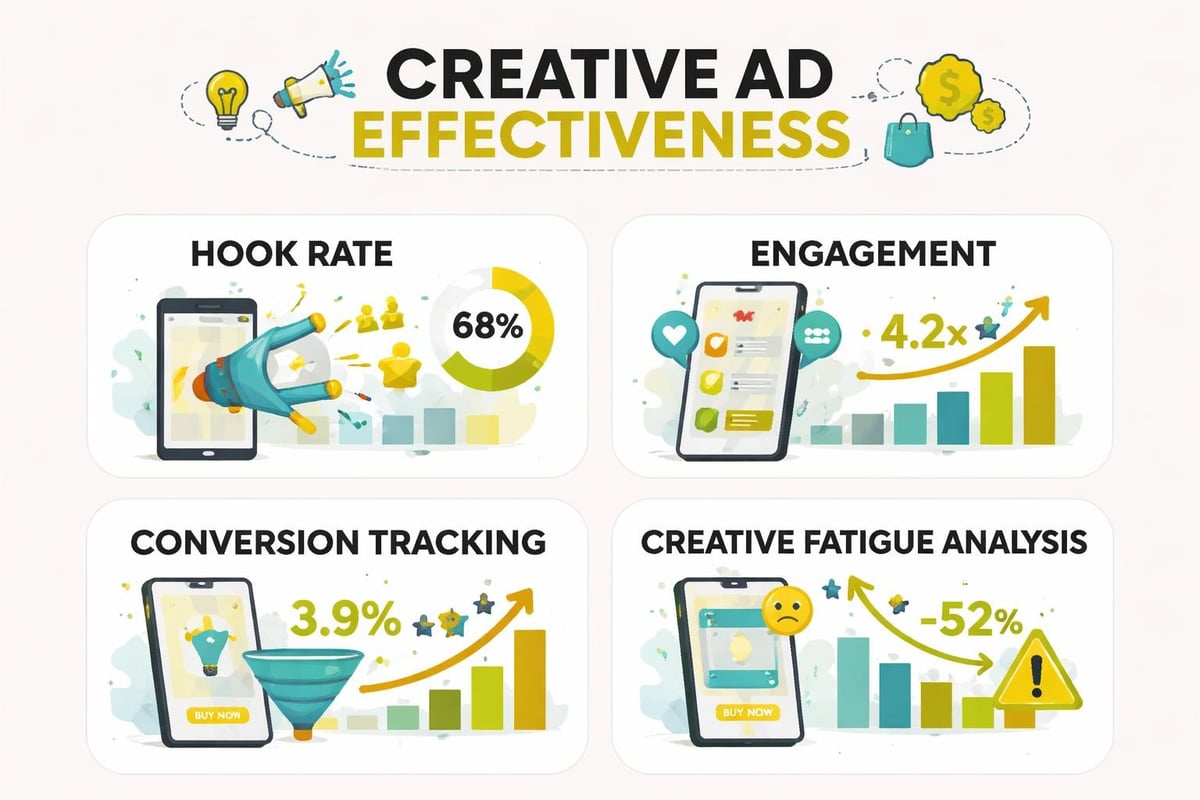
- Hook rate - percentage of viewers who watch past 3 seconds
- Hold rate - percentage completing 50%, 75%, 95% of video
- Thumb-stop ratio - impressions to 3-second views
- Creative fatigue curve - performance degradation over time
- Cost per creative - production expense relative to revenue generated
Building a Creative Analytics Dashboard
Consolidate creative performance data in centralized dashboards that enable quick decision-making and pattern recognition.
| Metric | Target Range | Red Flag Threshold | Action Required |
|---|---|---|---|
| Hook Rate | >35% | <20% | Revise opening 3 seconds |
| CTR | >1.5% | <0.8% | Update value proposition |
| Conversion Rate | >3.5% | <2.0% | Align creative with landing page |
| Frequency | 2-4 | >6 | Refresh creative immediately |
Fashion brand Reformation attributes 40% of its ecommerce growth to sophisticated creative analytics that identify winning patterns and failing elements within 48 hours of campaign launch.
Shopify-Specific Creative Advantages
Brands operating on Shopify benefit from unique creative advertising advantages compared to legacy platforms like Magento or WooCommerce. The platform's modern architecture and integrations enable faster creative deployment and better performance tracking.
Seamless Creative-to-Commerce Integration
Shopify's native integrations with Meta, TikTok, Google, and Pinterest allow dynamic product catalogs that automatically update creative elements based on inventory, pricing, and performance.
Shopify creative benefits:
- Automated product feed updates ensure creative accuracy
- Dynamic retargeting based on browsing and cart behavior
- Faster page load times improve ad-to-site experience
- Built-in A/B testing for landing pages matching ad creative
- One-click checkout reduces friction from ad click to purchase
Brands migrating from Magento to Shopify typically see 25-35% improvement in conversion rates from ads due to superior site speed and mobile optimization that complements creative advertising efforts.
Creative Testing Velocity
Shopify's ecosystem enables rapid creative iteration that's challenging on other platforms. The combination of fast site performance, easy page building, and robust app marketplace accelerates the test-learn-optimize cycle.
When home decor brand Parachute migrated to Shopify, their creative testing velocity increased 3x, enabling monthly creative refreshes that maintained campaign performance while competitors struggled with creative fatigue.
Seasonal and Campaign-Specific Creative Strategies
Creative advertising effectiveness varies dramatically based on timing, audience mindset, and competitive context. Strategic brands plan creative calendars that align with customer journey stages and seasonal opportunities.
Building a Creative Calendar
Plan creative themes and campaigns 90 days in advance, allowing time for production while maintaining flexibility for trending opportunities.
Quarterly creative planning framework:
- Q1 (January-March) - New Year goals, fresh starts, self-improvement
- Q2 (April-June) - Spring refresh, outdoor living, summer preparation
- Q3 (July-September) - Back-to-school, fall preview, early holiday
- Q4 (October-December) - Holiday gifting, year-end sales, new year preview
Beauty brand Summer Fridays plans creative themes quarterly while maintaining weekly flexibility for trending topics and viral opportunities, achieving 60% higher engagement during peak seasons compared to reactive competitors.
Holiday Creative Best Practices
Peak shopping periods like Black Friday, Cyber Monday, and holiday seasons require distinct creative approaches that break through heightened competition.
- Start creative production 6-8 weeks before key dates
- Test gift-focused messaging versus self-purchase angles
- Create urgency without appearing desperate or salesy
- Develop sequential creative that tells story across customer journey
- Prepare creative variants for different discount levels
Lifestyle brand Anthropologie generated $12 million in incremental holiday revenue through creative advertising campaigns that balanced gift inspiration with promotional messaging, testing dozens of creative variants to find optimal performance combinations.
Leveraging AI and Emerging Technologies
Artificial intelligence tools are transforming creative advertising production and optimization. Amazon's Creative Agent represents just one example of how AI accelerates creative development while maintaining quality standards.
AI-Powered Creative Tools
Modern creative workflows incorporate AI at multiple stages, from initial concept to final optimization.
AI applications in creative advertising:
- Image generation and variation creation
- Copy optimization and A/B test suggestion
- Automated background removal and product isolation
- Video editing and caption generation
- Performance prediction before campaign launch
However, AI tools work best when guided by human creative strategy and brand understanding. The most effective approach combines AI efficiency with human creativity and strategic thinking, ensuring technical capabilities serve brand objectives rather than replacing strategic judgment.
Building Internal Creative Capabilities
While agencies provide valuable expertise, developing internal creative competencies enables faster iteration and deeper brand alignment. The most successful ecommerce brands balance agency partnerships with in-house capabilities.
Essential In-House Creative Skills
Build these competencies internally:
- Basic photography and video production for UGC-style content
- Mobile editing using apps like CapCut, InShot, or Canva
- Platform-specific creative formatting and specifications
- Performance analysis and creative testing protocols
- Brand guidelines documentation and enforcement
Fashion brand Everlane built an internal creative team of 12 that produces 80% of their advertising creative, enabling daily campaign updates and real-time response to performance data. Their hybrid model combines internal production with agency support for major campaigns and strategic direction.
Agency Partnership Optimization
When working with specialized ecommerce agencies, establish clear workflows that maximize creative output and performance.
Effective agency collaboration:
- Share comprehensive brand guidelines and creative examples
- Establish weekly creative review cycles with clear feedback
- Provide direct access to performance data and analytics
- Set specific creative KPIs beyond basic campaign metrics
- Create shared creative libraries for asset organization
The most productive agency relationships balance creative freedom with performance accountability, ensuring campaigns achieve both brand elevation and measurable business outcomes.
Cross-Channel Creative Consistency
While platform-specific optimization is essential, successful brands maintain creative consistency across touchpoints. This coherence strengthens brand recognition and improves overall campaign efficiency.
Building a Creative System
Develop flexible creative frameworks that adapt to different platforms while maintaining recognizable brand elements.
Core consistency elements:
- Color palette application across all creative
- Typography hierarchy and font usage
- Photography and imagery style guidelines
- Tone of voice in copy and messaging
- Logo placement and sizing standards
Wellness brand Ritual maintains distinctive purple branding and clean photography style across all platforms while adapting content format and messaging to each channel's unique requirements. This consistency contributes to 92% brand recall among their target audience.
Omnichannel Creative Strategy
Modern customer journeys span multiple touchpoints before conversion. Strategic creative advertising accounts for this complexity through coordinated messaging.
Track customer exposure across platforms and adjust creative accordingly. Someone who viewed a Meta ad but didn't convert should see different creative in Google Display retargeting, advancing the narrative rather than repeating it.
Conversion rate optimization extends beyond landing pages to encompass the entire creative journey from first impression through post-purchase communication.
Learning from Award-Winning Creative
Studying recognized creative excellence provides inspiration and tactical insights. The Cannes Lions International Festival of Creativity and similar awards showcase campaigns that successfully balance creativity with effectiveness.
Common Patterns in Winning Creative
Analysis of award-winning ecommerce campaigns reveals consistent patterns that drive both recognition and results.
Characteristics of exceptional creative advertising:
- Authentic human stories rather than product features
- Unexpected executions that surprise and delight
- Cultural relevance and timely commentary
- Technical innovation in format or delivery
- Measurable business impact beyond creative metrics
Beauty brand Dove's "Real Beauty" campaign remains one of the most effective creative advertising examples, generating over $1 billion in incremental sales while winning numerous creative awards. The campaign succeeded by addressing genuine customer emotions rather than promoting product specifications.
Creative advertising represents the crucial intersection where brand building meets performance marketing. The most successful ecommerce brands in 2026 reject the false choice between creativity and conversion, instead developing integrated approaches that deliver both memorability and measurable results. If you're ready to develop creative advertising strategies that drive growth while building lasting brand equity, Good Karma Agency combines data-driven performance expertise with creative excellence specifically designed for fast-growing ecommerce brands. Our integrated approach to Shopify development, creative production, and performance marketing ensures your campaigns achieve both immediate conversions and long-term brand value.


